
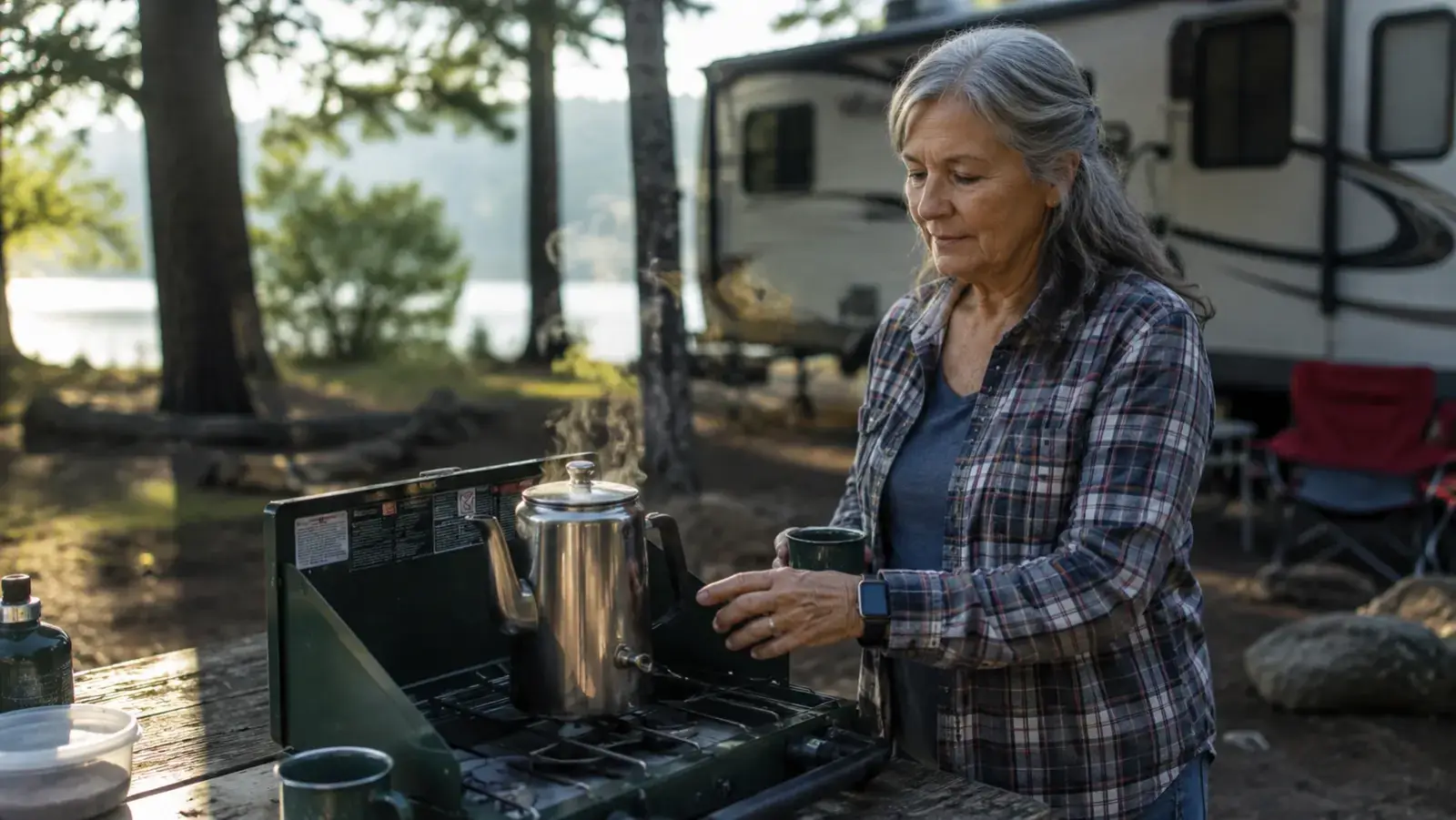
Six months ago I set the Farberware Classic Yosemite stainless percolator on my camp stove for the first time and made myself a promise. I would not write a single word about it until I had a full season behind it, because a review after one good weekend tells you nothing about how stainless steel actually behaves after fifty mornings of open flame, hard water from half a dozen different campgrounds, and being packed away wet more times than I care to admit. This is that six-month report. Not the one I could have written in week one, when everything still looked brand new and I still liked the sound of my own optimism.
I bought this 8-cup pot to replace a little single-serve pod machine I used to run off the trailer's inverter, and I was tired of it for two reasons. It drained battery I needed for other things, and the coffee it made never tasted like much of anything worth getting up for. Six months of near-daily use later, on a camp stove most mornings and a fire grate whenever the weather cooperated, I finally have enough miles on this thing to tell you how it holds up, not just how it performed the first week out of the box.
The Quick Verdict
A stainless percolator that earns its keep over real time, scorches if you walk away from it, and rewards you the day you finally learn its timing.
Amazon Check Today's Price →If your camp coffee has been a letdown for six mornings running, it's not you. It's the pot.
This is the exact percolator I've used almost daily for six months, the same 8-cup Farberware, no substitutions, no upgrades I had to make later.
Amazon Check Today's Price on Amazon →How I've Used It
I don't camp a few weekends a year. I camp most of the year now that I'm retired, pulling my 24-foot trailer between state parks and Corps of Engineers campgrounds with Biscuit riding along, usually mid-week when the loops are quiet. That means this percolator hasn't sat on a shelf between trips. It rides in the outside kitchen bin of the trailer and comes out most mornings whether I'm at a full-hookup site or a primitive one with nothing but a fire ring and a picnic table.
Over these six months it's made coffee at a Corps of Engineers campground on Kentucky Lake more times than anywhere else, plus four different state parks and two more Corps campgrounds scattered around. That's the point of this review. Different water, different stove setups, different weather, all landing on the same pot. I wanted to know if a percolator that impressed me in April would still impress me in September, after enough scorched mornings and hasty cleanups to actually test it.
I brewed it on a two-burner propane camp stove most mornings, and directly on a fire grate over coals maybe once a week when I had a fire going anyway. Both methods work with this pot, but they don't age it the same way, and that difference is most of what this review is actually about.
The stretch from April to September also meant this pot saw real weather swings, not just a handful of mild mornings. It brewed coffee at Kentucky Lake in a spring downpour with the camp stove tucked half under the awning, and it brewed coffee at a state park in July when the air was already eighty degrees by seven in the morning and I still wanted something hot. A pot that only gets tested in perfect conditions doesn't tell you much. This one had no choice but to earn a real answer.
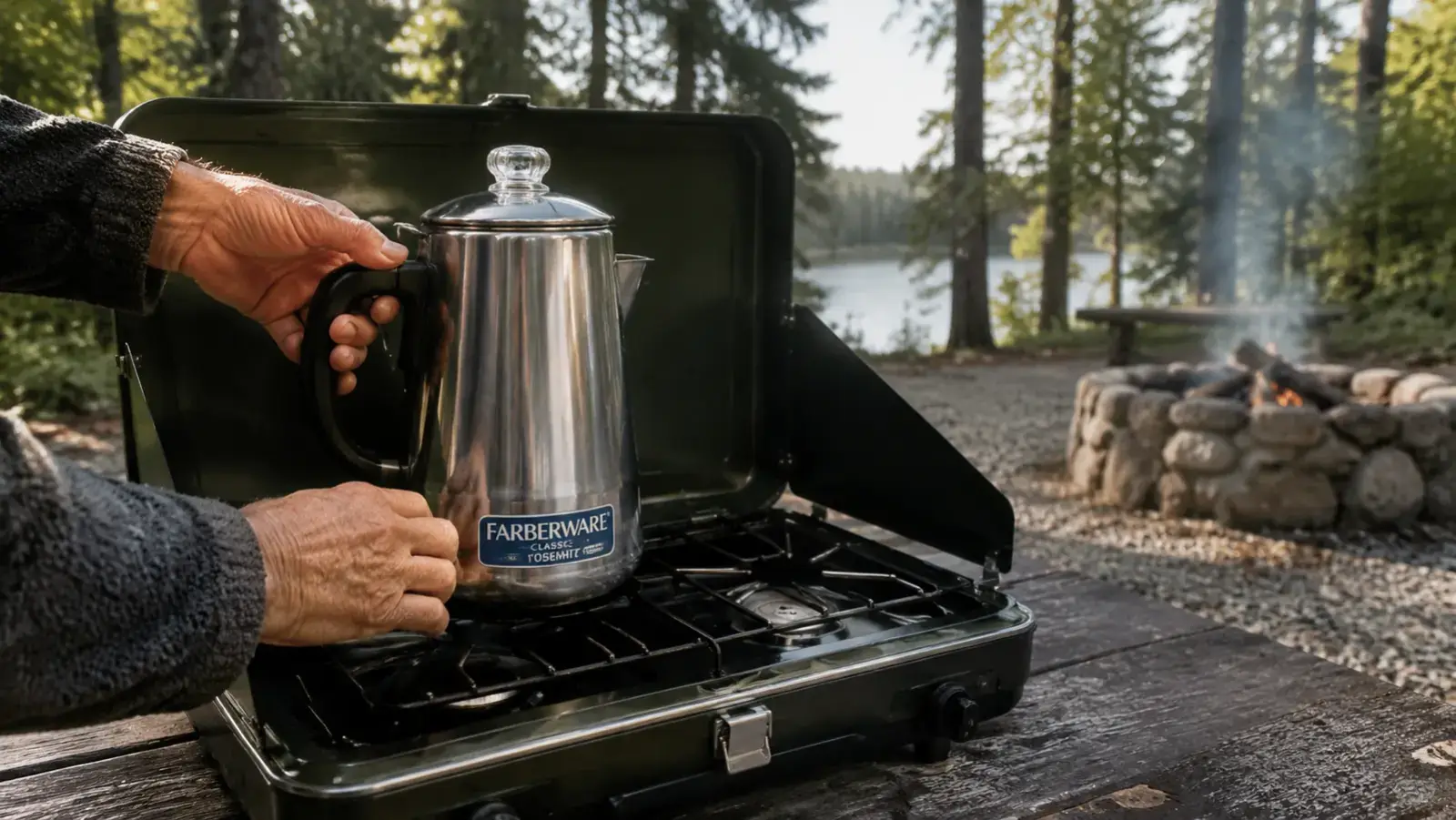
What Six Months Over Open Flame Actually Does to Stainless Steel
The bottom of this percolator does not look like it did in month one, and I want to be upfront about that instead of pretending stainless steel is magic. Direct flame from a camp stove leaves a ring of gold and blue discoloration on the base within the first few uses, the kind of heat tinting you'd expect on any stainless pan that spends real time over a burner. Coal heat from the fire grate is worse. Twice this season I set it directly on hot coals and walked away to break down the tent, and both times I came back to a scorched black ring climbing partway up the sides that no amount of scrubbing has fully lifted. A third time I caught it early, pulled it off the coals the moment I smelled something, and the mark from that one morning is noticeably lighter than the other two, so timing matters more than I expected.
None of that discoloration has affected how the pot works. The percolator still seals, still perks, still pours clean six months in. But if you're the kind of person who wants gear that photographs like new after every trip, know that this pot will not stay showroom bright once it meets real flame. Mine looks like it's been camping, because it has.
What has held up better than I expected is the handle and the lid knob, both of which get gripped hot and dropped in a hurry more mornings than I'd like to admit. Neither has loosened, warped, or gone wobbly, which is more than I can say for a cheaper percolator I ran through two seasons before this one, where the lid knob worked itself loose by midsummer every single year.
The Basket and Stem, Fifty Mornings Later
The basket and center stem are the parts I worried about most going in, because they're the part of any percolator doing the actual work, and they're small enough to lose or bend if you're not careful with them. After what I'd estimate is somewhere north of a hundred and fifty brews, the basket still sits flush on the stem, the stem still stands straight in the pot, and the little perforated lid on the basket still snaps on tight enough that grounds don't work their way loose into the coffee.
That last part matters more than it sounds like it should. I've had grounds slip past a worn basket lid on an older percolator I owned years ago, and gritty coffee first thing in the morning is not a small annoyance when you're already up before the sun cranking stabilizers and hauling water. This basket hasn't done that to me once, not even after being dropped on a gravel pad twice and once, embarrassingly, into the lake shallows while I was rinsing it.
The one wear point I've noticed is a slight looseness in how the stem sits inside the basket's center tube, enough that it rattles a little when I pack the pot away. It hasn't affected the brew and it hasn't gotten worse over the last two months, but I notice it, and I expect I'll be watching it going into next season to see if it turns into a real problem or stays a minor rattle.
Cleaning It Without a Sink
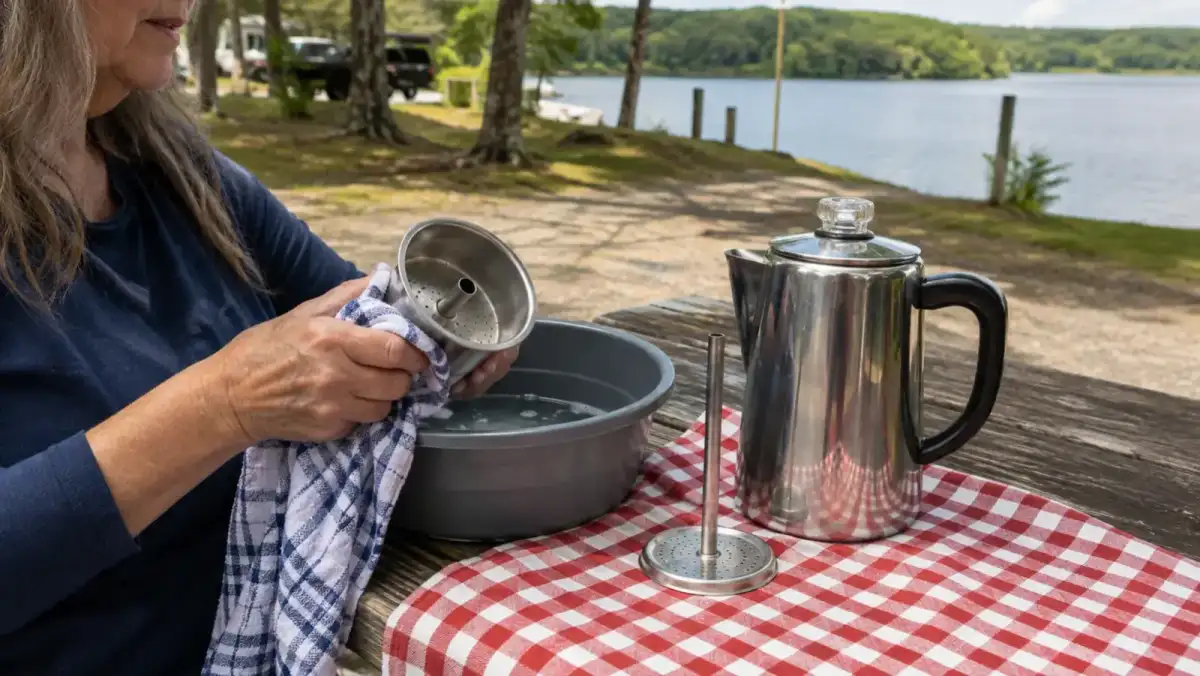
This is the part nobody tells you about camp percolators, and it's a bigger factor in long-term satisfaction than the coffee itself. I don't have a kitchen sink most mornings. I have a wash basin, a jug of water heated on the stove, and whatever daylight I've got before I need to be somewhere else. Cleaning a percolator under those conditions is a different job than cleaning one at a real sink with a sprayer and hot tap water on demand.
The good news is that the wide mouth on this pot makes it manageable. I can get a hand and a scrub brush all the way to the bottom without contorting my wrist, which is not true of every percolator I've handled. The basket and stem lift out clean and rinse fast in the basin. Where it gets slower is the scorch ring from the fire grate mornings, which takes real scrubbing with a paste of baking soda and a little water to knock back, and even then it never fully disappears.
There was one week at a state park with no water hookup at all, just a shared spigot a short walk from the site, where I let two mornings of coffee grounds sit in the basket longer than I should have because I didn't want to make the walk twice. By the third morning the basket smelled sour and the coffee tasted worse for it, which was entirely my doing and not the pot's fault. That's the honest lesson from six months of this. A percolator with no sink nearby only stays pleasant if you rinse it the same day, every day, no exceptions.
My routine now is to rinse it right after brewing, while it's still warm and the grounds haven't set, and save the harder scrubbing for whenever I have a full basin of hot water anyway, usually dish duty after supper. Doing it that way, cleanup takes me under five minutes most mornings, closer to fifteen on scorch days. That's a fair trade for coffee that actually tastes like coffee, but it's not a zero-effort pot, and I'd rather tell you that now than have you find out the hard way at a primitive site with no sink in sight.
Learning the Timing Changed Everything About the Taste
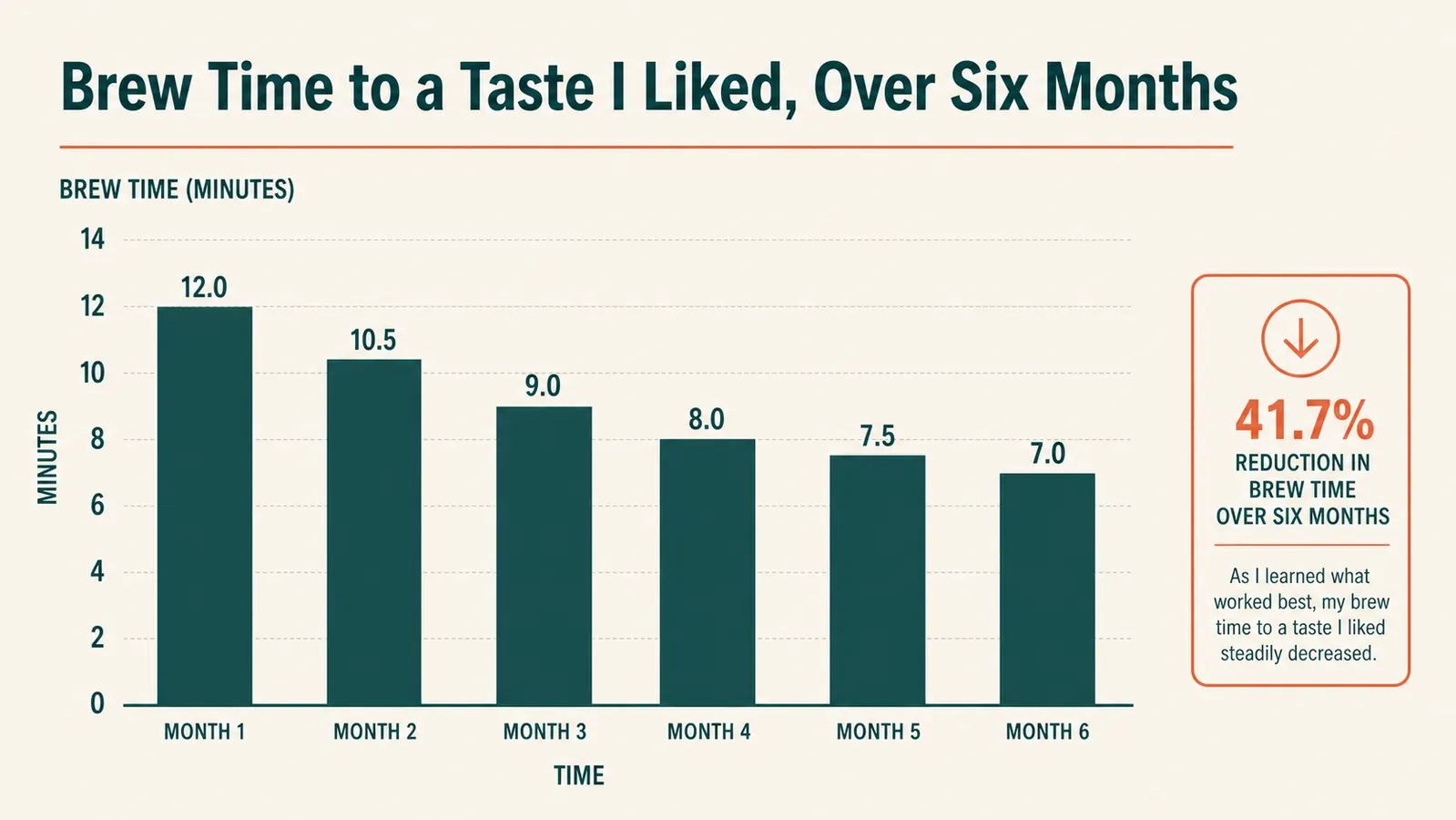
My first month with this percolator, the coffee was rough. Bitter some mornings, weak others, and I nearly gave up on the whole idea and went back to the pod machine more than once. What I hadn't accounted for is that a percolator this size behaves differently depending on your stove's flame, your altitude, and even how cold the morning air is, and none of that is written on the box. It took real trial and error, probably six or eight brews of genuinely bad coffee, before I found my rhythm.
By month three I'd settled into a routine that works nearly every time. Medium flame, a coarser grind than I used to buy, and pulling it off heat the moment I hear the perk slow down rather than counting minutes on a clock, since the timing shifts with the weather more than I expected. By month six that routine is close to automatic, and the coffee it produces most mornings is genuinely good, strong without turning bitter, the kind of cup that made me stop missing the pod machine entirely somewhere around week nine.
That learning curve is the honest tradeoff of this pot compared to something like a French press, which I've also run side by side with this percolator on plenty of mornings and written up separately in my percolator versus French press comparison. A press is more forgiving on timing. This percolator asks you to pay attention for a while before it starts rewarding you consistently, and if you want the fuller case for why I think that trade is worth making at camp, that's in my reasons a percolator beats instant coffee piece.
What I Liked
- Wide mouth makes hand-washing in a camp basin actually manageable
- Handle and lid knob have stayed solid through six months of hot, hurried use
- Basket and stem still seal tight after well over a hundred brews
- Once you learn the timing, the coffee is genuinely good, not just camp-good
- 8-cup size covers me plus a guest without a second pot
Where It Falls Short
- Direct flame and coals leave permanent discoloration on the base and lower sides
- There's a real learning curve before the coffee tastes right consistently
- Scorch marks from fire-grate brewing take real scrubbing and never fully lift
- Slight rattle developing between the stem and basket tube after six months
- Not a grab-and-forget pot, it wants some attention while it's perking
It took eight bad cups before I understood this pot. Once I did, I stopped missing the machine I'd hauled a battery around for.
Who This Is For
This percolator is for someone who camps often enough that the learning curve is worth climbing, not someone making coffee at camp twice a summer. It's for a solo or two-person camp where an 8-cup pot is plenty, and for anyone who's decided they'd rather manage flame and timing themselves than depend on a battery-powered machine that dies the one morning you actually need it. If you already run a camp stove or build a fire most mornings anyway, this fits right into a routine you've already got.
Who Should Skip It
If you camp rarely enough that you'll be relearning the timing from scratch every trip, this pot will frustrate you more than it rewards you. It's also not the right pick if you want gear that stays looking new, since flame discoloration is permanent and shows up fast. And if mornings at camp are already rushed and you can't spare the attention a percolator wants while it's perking, a French press or a simple pour-over will serve you better with less to think about.
Six months, dozens of campsites, one pot that still does the job.
Same 8-cup Farberware Classic Yosemite percolator I've used almost every morning since April. It'll show some scorch marks eventually. It'll still make good coffee.
Amazon Check Today's Price on Amazon →