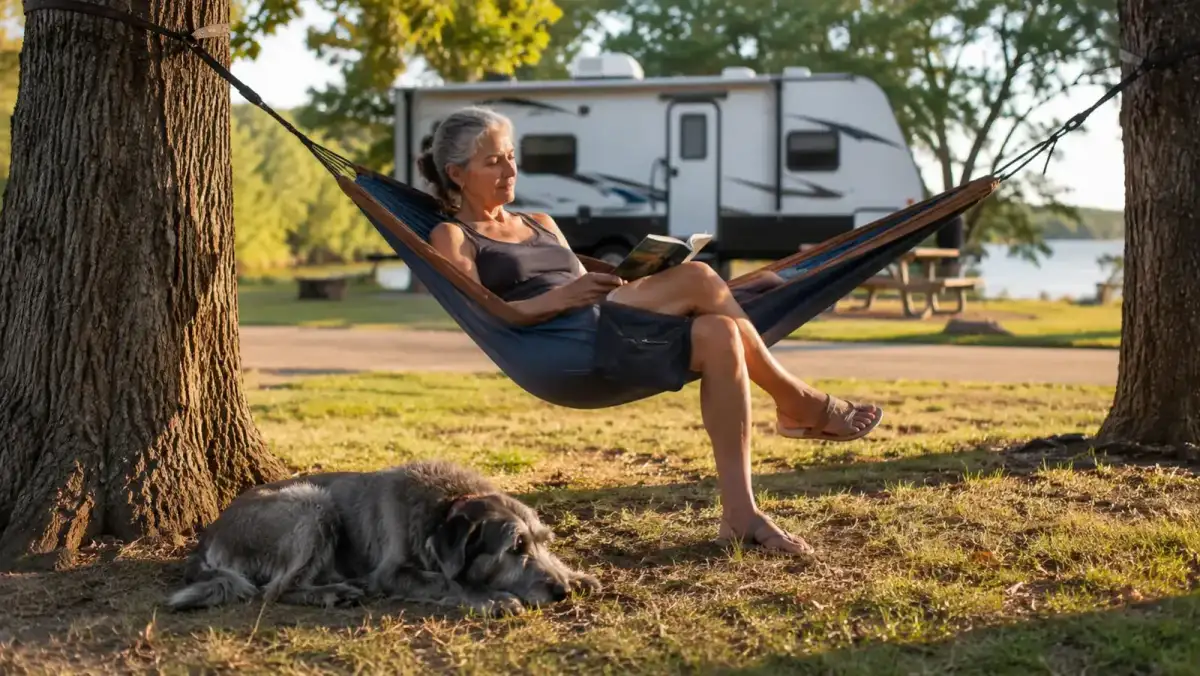
I've hung the Wise Owl Outfitters camping hammock so many times now that I stopped counting sometime in the middle of summer, but between my memory and the photos on my phone, I can put the number at somewhere past a hundred separate hangs across one full camping season. That season started in April at a Corps of Engineers campground on the Kentucky Lake shoreline, a mid-week stay with the loop nearly empty, and it ran through a cold snap in late October at one of my regular state parks. This isn't a first-week impression. This is what I actually know about this hammock, and specifically these tree straps, after wrapping them around more pine trunks, oak trunks, and one genuinely stubborn cedar than I could name individually if you asked me.
I'm Lorna Pruitt. I'm sixty-six, retired after twenty-eight years driving a school bus for a small district, and I spend most of the year now pulling my 24-foot travel trailer between state parks and Corps of Engineers campgrounds with my dog Biscuit riding along and my two cats, Pearl and Sable, holding down the trailer while we're outside. I camp alone. Nobody is standing at the other end of a hammock strap helping me pull it tight, and nobody is going to notice if a piece of gear quietly stops working right until I'm the one stuck with it. That's the lens this whole review runs through. Not weight. Not how it photographs. Whether it still does its job for one tired person after a real season of use, not just the first weekend out of the box.
The Quick Verdict
After a full season and well over a hundred hangs, the fabric and straps still perform like new. The stuff sack shows its age. Everything that touches the trees does not.
Amazon Check Today's Price →If you're wondering whether a hammock this cheap actually lasts a season, I can tell you mine did.
Same hammock, same tree straps, still hanging tight after well over a hundred pack-downs. Here's the one I've been using all season.
Amazon Check Today's Price on Amazon →How I've Used It
This isn't an occasional-weekend hammock in my case. Once I'm parked somewhere for more than a single night, it comes off the trailer and goes up between two trees within the first fifteen minutes, usually before I've even leveled the trailer all the way. I've hung it at that original Corps of Engineers site on Kentucky Lake, at four different state parks since, and at two more Corps campgrounds after that, always mid-week when I can manage it, always in shoulder season when the crowds have thinned out and the trees I want are actually available.
Some of those stays were three nights. A few stretched to a full week. Across April through October, I'm estimating I hung this hammock somewhere between ninety and a hundred and twenty separate times, which means it also came down and got stuffed back into its little sack that same number of times. That's the part that actually tests a piece of camp gear. Anyone can look good the first weekend. What I wanted to know, and what I think most people considering this actually want to know, is what a whole season of daily use does to it, not what it looks like fresh out of the packaging in a photo.
I should say up front that I'm not rough on gear on purpose, but I'm also not gentle out of caution. I climb in with my boots on more often than I'd like to admit. I've hung it in wet weather and let it dry out still hanging rather than pack it damp, and a few times I packed it damp anyway because the sky wasn't cooperating and I needed to get moving. This review reflects that kind of real, slightly imperfect use, not a controlled lab test, and I think that's the only kind of long-term review actually worth reading before you spend your own money.
The Fabric, Stitching, and Straps After Real Miles
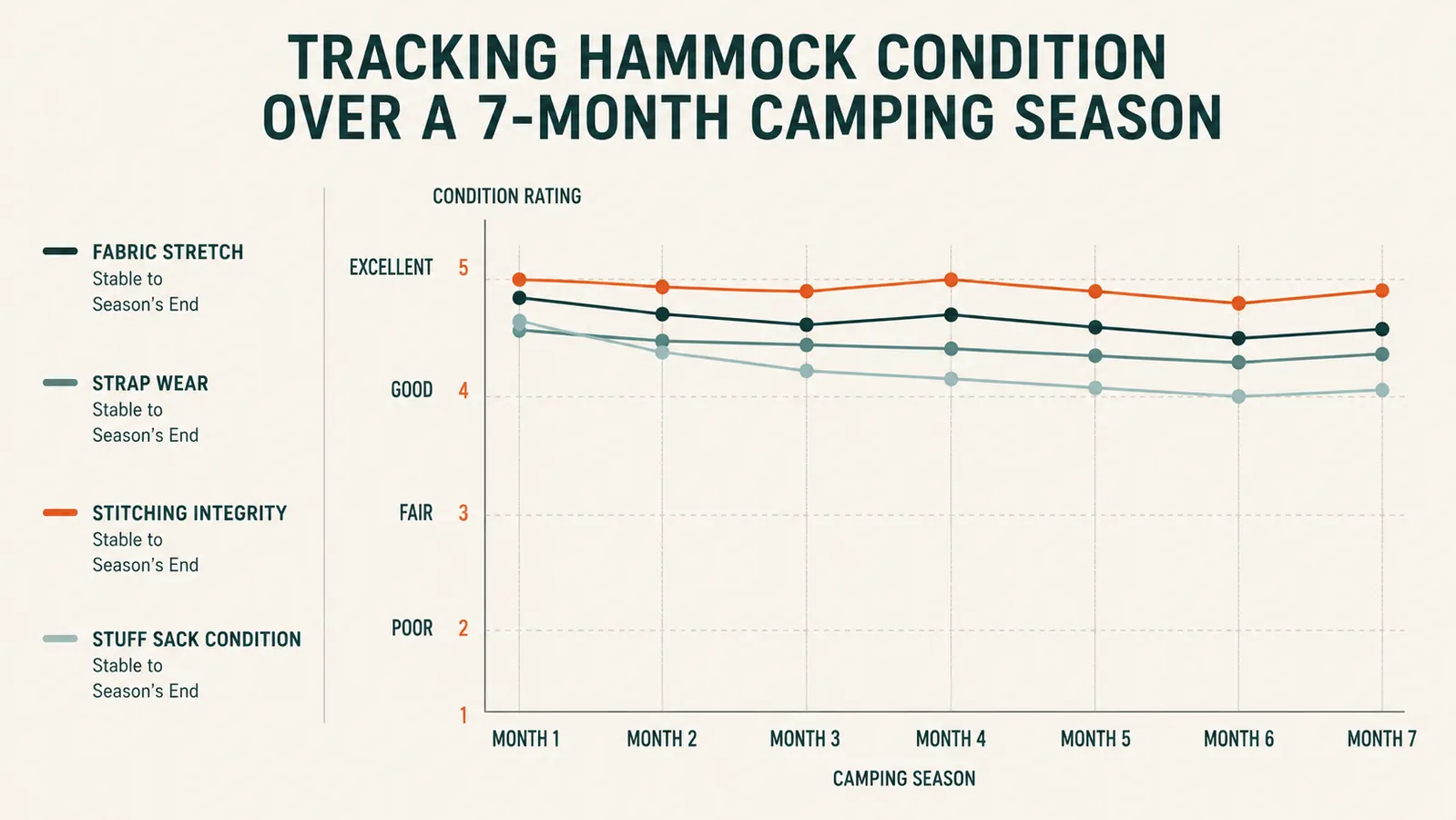
the Wise Owl hammock body is a lightweight parachute-style nylon, and the thing I watched for all season was stretch. Fabric like this can develop a permanent sag over time if the weave starts to give, and a hammock that sags too deep stops being restful and starts being a chore to climb out of, which matters more to me at sixty-six than it might to a twenty-five-year-old. Comparing photos from that first week in April against photos from October, I can see a small amount of additional give when I'm lying in it fully, maybe an inch or two lower at the center than when it was new. That's ordinary settling in fabric like this, not a failure, and it hasn't gotten worse since about midsummer. It found its stretch and stopped there.
The stitching at both end points, where the fabric gathers and connects to the carabiner loop, is the part I check every single time I hang it now, out of habit more than worry. I haven't found a loose thread or a popped stitch anywhere on either end after a full season. That's the detail that actually earns my trust in a hammock, more than the fabric itself, because that's the seam holding all your weight the moment you commit to lying down in it, and it's the one place I'd never want to discover a problem the hard way.
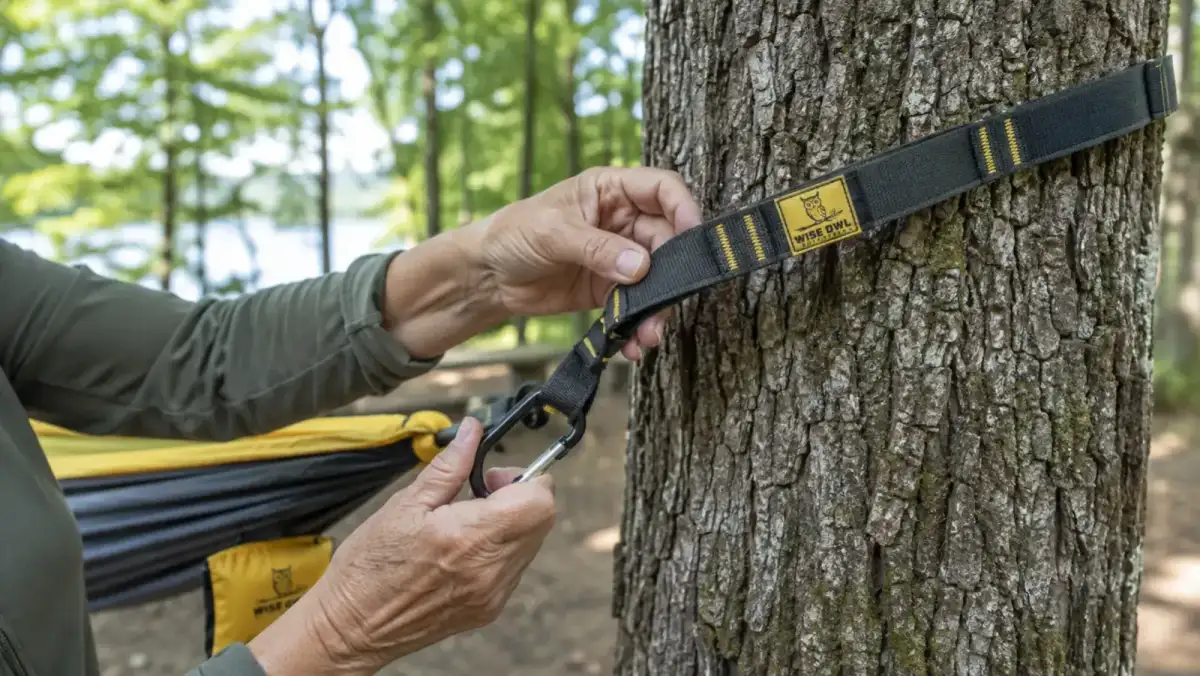
The included tree straps are daisy-chain webbing, and they've taken the worst of the sun and dirt all season since they're the part wrapped directly around bark. They've faded a shade lighter than when they were new and picked up some ground-in dirt that a wipe-down doesn't fully lift anymore. What they haven't done is stretch, fray at the stitched loops, or slip while I was in the hammock. Not once, across every campsite I've used them at, including a couple of trees with smoother bark where I expected more slide than I ever actually got.
What a Hundred Pack-Downs Actually Looks Like
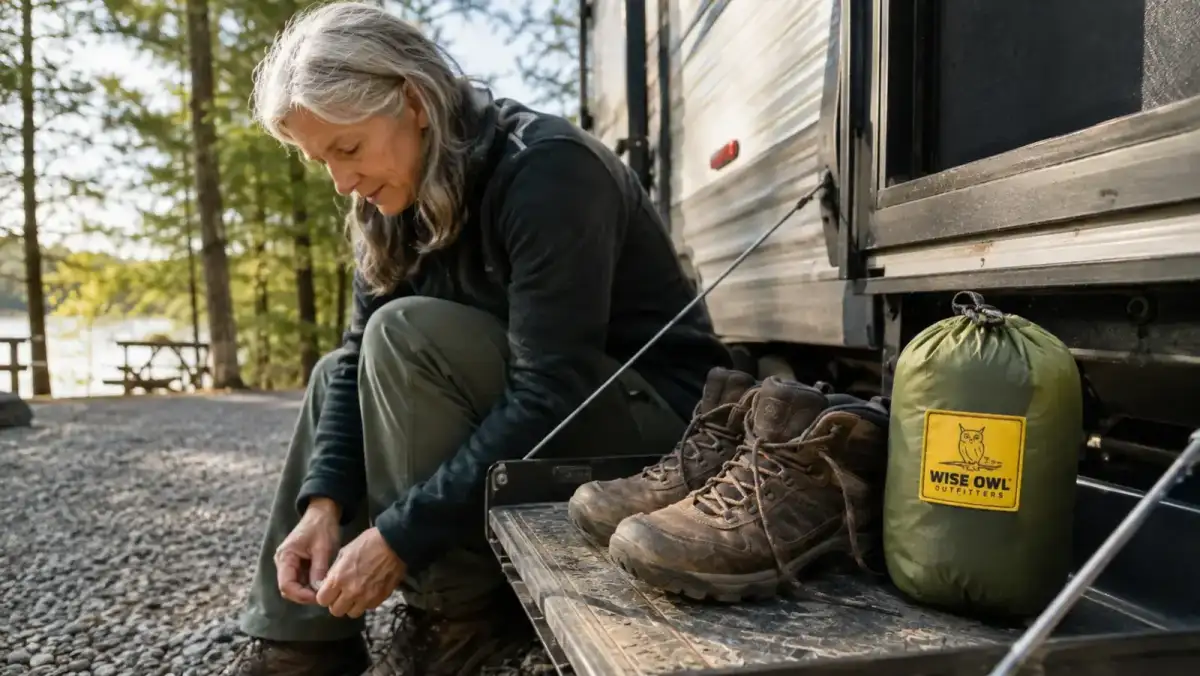
Packing this hammock down is the part of the routine I do the most, more often than actually sleeping in it, since I stuff it away every single time I strike camp even for one night. It compresses to about the size of a large grapefruit, and it still does that after a full season, no argument, no extra folding trick required. That consistency mattered more to me than I expected going in, because gear that gets harder to pack over time is gear you start avoiding, and gear you avoid stops earning its spot in the trailer, no matter how good it felt the first few times.
The stuff sack is the one piece I'd flag honestly. The drawstring cinch has loosened its bite a little, and there's some light fraying starting at the seam where the cord exits the bag. It still closes and it still does the job, but I can tell it's the component that's aged the fastest of anything in the set, faster than the straps, faster than the hammock fabric itself. If I had to guess which part gives out first over another full season, it's that bag, not the hammock, and I've already got a spare stuff sack from another piece of gear set aside just in case.
I've hung it in pine, in oak, and in that one stubborn cedar that made me walk ten feet down the site looking for two trunks close enough together to work. None of that variety changed how the straps behaved. What changed the pack-down routine slightly was weather. Packing it away wet a few times left a faint mildew smell after a couple of days sealed in the trailer's pass-through storage, which aired out fine once I hung it to dry properly, but it's a habit I'd tell anyone to build early rather than learn the way I did, the hard way, twice.
Where It Held Up and Where I Started Watching It
The honest tradeoff after a full season is this. The parts that touch the trees and hold your weight, the fabric, the stitching, the strap webbing itself, have held up better than I expected for a hammock in this price range. I didn't buy an expensive one, and I went in prepared for the straps to be the weak link. They weren't. What's aged is the accessory, the stuff sack, which is the least important part functionally but the part you handle every single time you set up or break down camp.
The other thing I'd flag for someone reading this before buying is that this hammock rewards a routine. Dry it before you pack it, check the stitching out of habit even though it's held up fine for me, and don't leave it strung up in direct sun for days at a time between uses, since that's when fabric like this fades and weakens fastest. I learned that by watching what happened to a strap I accidentally left hanging on a tree for four days at one site while I was distracted with other camp chores. It faded noticeably faster than the ones I take down each morning without fail.
The Alternative I Almost Bought Instead
Before I settled on this one, I seriously considered an ENO hammock, since that's the name most people mention first when this topic comes up at the campground or in the online groups I follow. I ended up writing out the full comparison separately in Wise Owl versus ENO, but the short version is that the price difference was the deciding factor for me, and after a full season I don't feel like I gave anything up by going with the less expensive option. Whether that holds for someone who wants a double-wide hammock for two people is a fair question I can't answer from my own use, since I've only ever hung the single, alone, the way I camp.
What I Liked
- Fabric and stitching show no meaningful wear after a full season and well over a hundred pack-downs
- Tree straps haven't stretched, frayed, or slipped even once across every campsite I've used them at
- Still compresses to roughly the same grapefruit-sized bundle it did on day one
- One person can hang it solo in under ten minutes at nearly any tree spacing
Where It Falls Short
- The included stuff sack is showing its age faster than anything else in the set
- A small amount of fabric stretch settles in during the first month or two of regular use
- Straps left up in direct sun for days at a time fade noticeably faster than ones taken down each morning
- Packing it away wet without airing it out first can leave a faint mildew smell
I didn't need to know if it was comfortable the first weekend. I needed to know if the straps I trust my weight to would still be trustworthy in October.
Who This Is For
This is for someone who camps often enough that gear actually gets tested, not just admired in the driveway once and then forgotten in a bin until next summer. If you're setting up camp by yourself, if you want something you can hang and take down in minutes without a second pair of hands, and if you'd rather spend on something modest that holds up than something fancier you're afraid to rely on, this held up its end of the bargain for me across a full season of real use, not a curated one built for a photo.
Who Should Skip It
If you're camping with a partner and want to share one hammock regularly, I'd look at the double-wide version of this or something built specifically for two from the start, since I've only tested the single and can't speak to how the straps and fabric hold up under that kind of extra, uneven weight over a season. And if you know you're the type to leave gear strung up between trips without a second thought, budget for replacing the stuff sack a season or two sooner than the rest of it, because that's the one piece that wore faster than I expected, well before anything that actually matters.
A full season in, this is still the hammock I reach for first.
Same straps, same fabric, still holding up after well over a hundred hangs and pack-downs. If you want the setup that made the difference for me, it's the one I linked in <a href="/10-reasons-camping-hammock-beats-a-tent">my piece on why I reach for a hammock over a tent</a> too.
Amazon Check Today's Price on Amazon →