
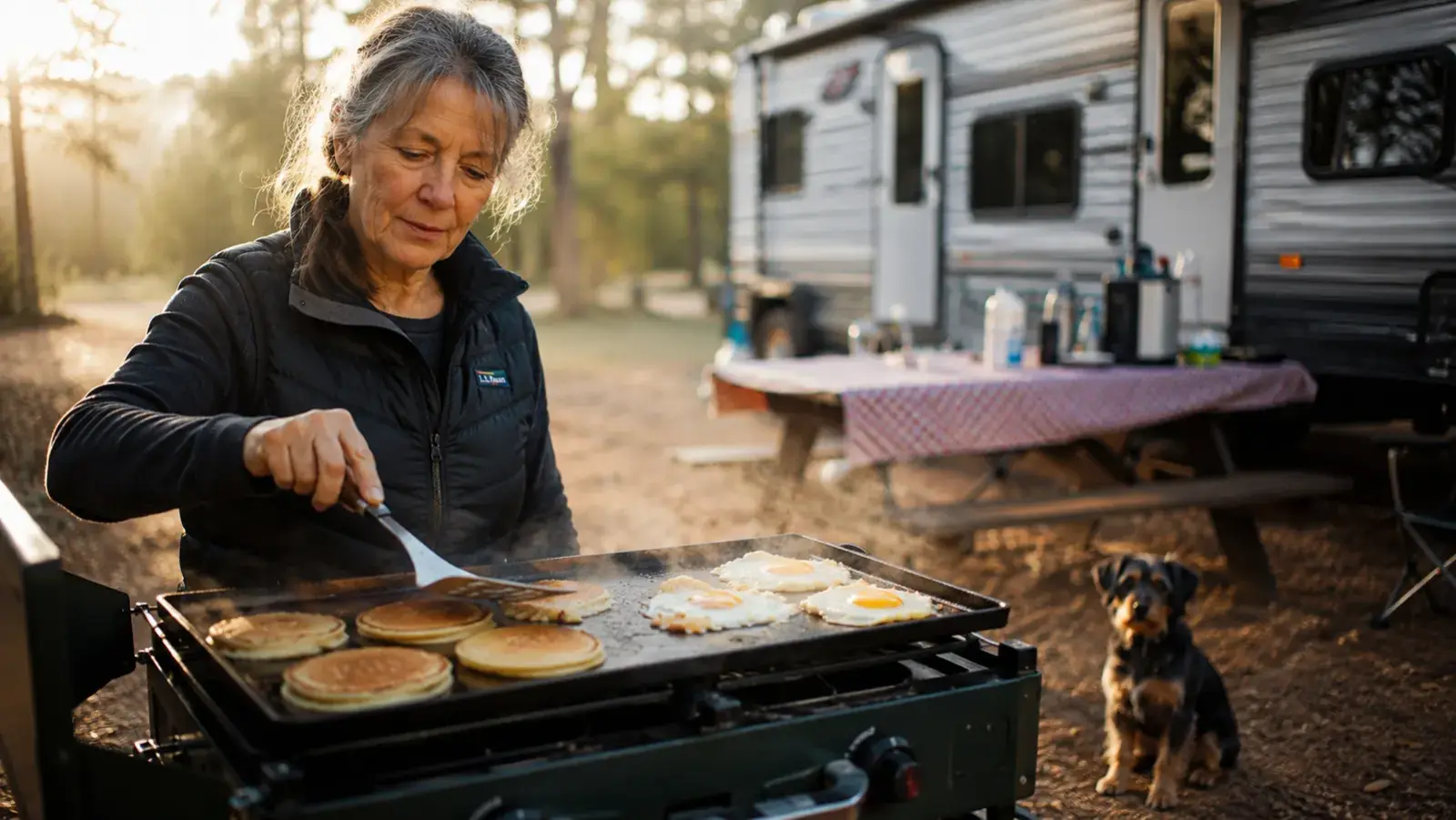
I bought this griddle in the spring of 2024 because I was tired of cooking bacon in one skillet, eggs in another, and pancakes in a third, all while trying to keep three pans balanced on a two-burner stove that only wants to hold two things at once. The Lodge reversible cast iron griddle solved that problem the first morning I used it, and it's been on my stove or over my fire ring at nearly every breakfast since. That's three full camping seasons now, four state parks, two Corps of Engineers campgrounds besides my usual spot on Kentucky Lake, and I've finally got enough time on this pan to tell you what actually happens to it over the long haul, not just what it does on day one.
This isn't a first-impressions review. It's what I've learned from hauling one flat piece of iron in and out of a trailer for three seasons, including the one time I nearly ruined it with a wet towel and a closed cabinet door.
The Quick Verdict
A genuinely durable pan that rewards patience with seasoning and punishes you a little if you pack it away damp, which I did exactly once.
Amazon Check Today's Price →Stop juggling three pans on a two-burner stove.
This is the same reversible griddle I've used for three seasons of camp breakfasts, ribbed side for the bacon, flat side for everything else.
Amazon Check Today's Price on Amazon →How I've Used It
I cook breakfast at camp most mornings I'm out, which these days is most mornings, period. Eggs, bacon, pancakes, sometimes hash browns if I planned ahead and brought potatoes. Dinner gets the griddle too, more than I expected when I bought it. Burgers, a grilled cheese when I don't feel like doing much, quesadillas when I have tortillas that need using up before they go stale in the trailer's small fridge.
It rides on my two-burner propane stove most of the time, straddling both burners since it's just wide enough to bridge them. I've also set it right on a campfire grate a handful of times, mostly at Corps of Engineers sites where the fire ring has a solid grate built in and I felt like cooking the old way instead of firing up the propane. Both methods have had a full season or more of use behind them at this point, so I'm not guessing about how this pan behaves under either kind of heat.
I'm the only one setting up and breaking down camp, so every pan I own gets judged partly on whether I can lift it, carry it, and clean it without help. This griddle passed that test early, but the answer got more complicated the longer I used it, which I'll get into below.
The Seasoning, Building Over Three Camping Seasons
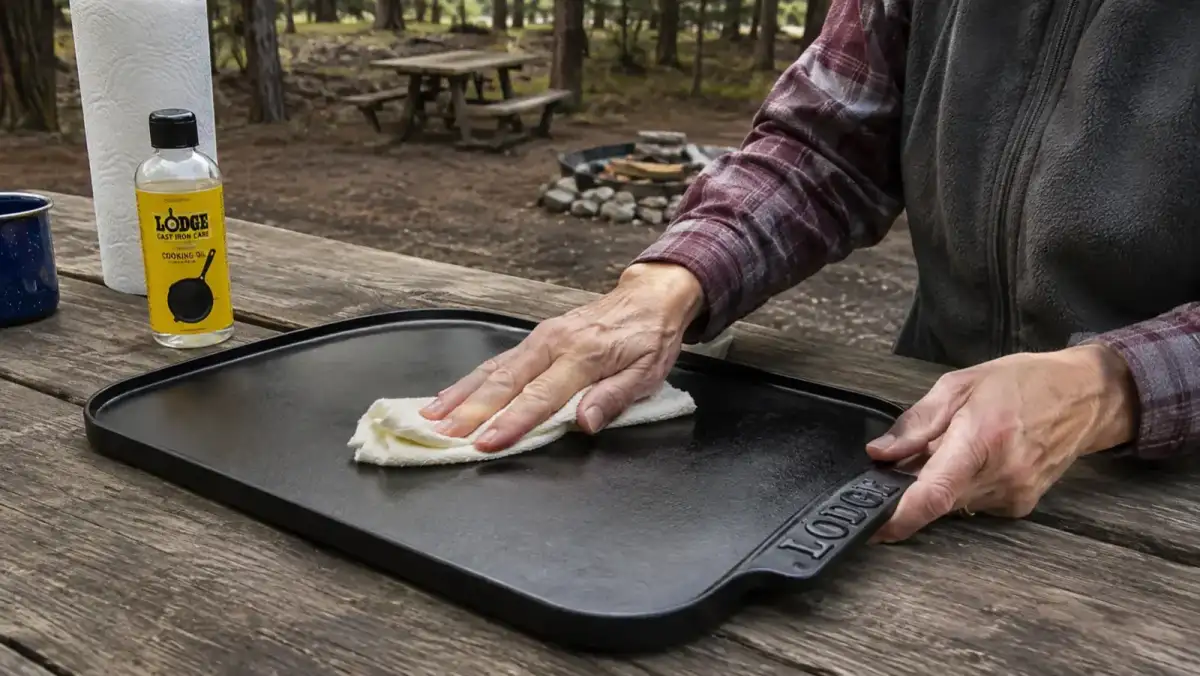
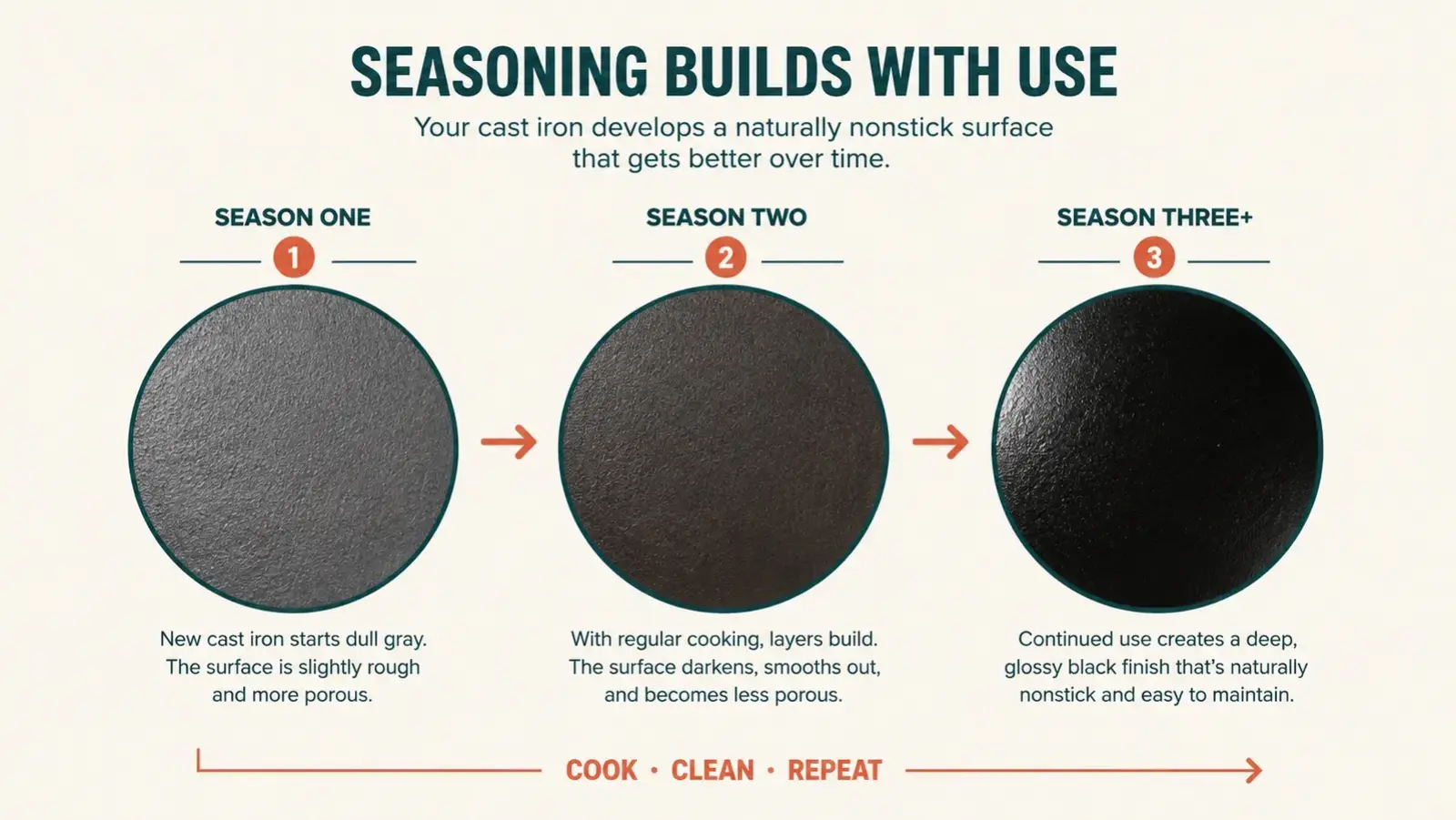
Lodge ships this pan pre-seasoned, and that first coat is fine, it works, food doesn't weld itself to the surface on day one. But pre-seasoned out of the box and properly seasoned after real use are two different things, and the difference showed up gradually over that first full season. By the end of season one, the flat side had gone from a dull, slightly rough gray-black to something noticeably smoother and darker, especially in the center where most of the cooking happens.
Season two is when it really turned a corner. Eggs started sliding rather than needing coaxed off the surface. I wasn't doing anything different, no special seasoning ritual beyond a light wipe of oil after most washes, just consistent use over enough months that the iron built up a proper patina. By the start of season three, both sides had a deep, almost glossy black finish, and the ribbed side in particular holds a nonstick quality now that surprised me for cast iron.
The part I want to be honest about is that this took real time. If you're buying this pan expecting nonstick performance out of the box, you'll be a little disappointed the first few uses. What you're actually buying is a pan that gets better every season you keep using it, which is a different kind of value than most camp cookware offers. I've got a full walkthrough of how I built that seasoning up on purpose, step by step, over in my guide to seasoning a cast iron camp griddle, if you want the exact routine.
The One Damp Pack-Down That Brought Rust
Here's the mistake I made, and I'm including it because it's the single most useful thing I learned about long-term ownership of this pan. Early in season two, I broke camp at a state park during a drizzly morning, packed everything up faster than usual because I wanted to beat worse weather on the drive out, and put the griddle away still slightly damp from a quick rinse, wrapped in a dish towel, into the closed cabinet in the trailer's outside kitchen.
Four days later, back home, I opened that cabinet to find faint orange freckling across about a third of the flat side. Not deep pitting, just surface rust, but rust all the same, sitting right there on a pan I'd spent a full season building up seasoning on. I felt sick about it for about five minutes.
The fix was straightforward. A scrub with fine steel wool, a full re-oil and a low-oven reseason, and the pan came back within a day looking nearly like it had before. But it set my seasoning progress back noticeably, and it taught me the one rule I now follow without exception: this pan does not go in a closed cabinet until it's bone dry and has a fresh film of oil on it, even if that means letting it sit out on the picnic table for an extra twenty minutes while I finish loading everything else. Cast iron doesn't forgive a damp, closed space, no matter how good the seasoning underneath it is.
Ribbed Side, Flat Side, and Learning When to Use Each
When I first got this pan, I assumed the ribbed side was mostly decorative, something Lodge added because grill marks look nice in photos. I don't think that anymore. The ribbed side has earned a real, specific job in my camp kitchen, and it's not the job I expected.
I use the ribbed side almost exclusively for bacon and burgers now, because it lifts the meat up out of its own grease, which matters a lot when you're cooking over a less-than-perfectly-level camp stove and don't want a pool of hot fat sloshing toward one edge. It also means less grease splatter on my hands when I flip something, which is a small thing until you're doing it solo balanced over a picnic table.
The flat side gets everything that needs even, direct contact with the surface. Eggs, pancakes, grilled cheese, quesadillas, hash browns. Anything where you want the whole surface of the food touching iron rather than sitting up on ridges. I flip the whole pan over between courses more mornings than not, bacon and burgers on the ribbed side first while the flat side is heating from underneath, then a flip so the flat side takes over for eggs and pancakes once the meat's done. It's a small choreography, but after three seasons it's second nature, and it means one pan genuinely does the job of two.
The Weight Question, Since I Load Everything Myself
This is the part that matters most to me and probably to a lot of people reading this who camp alone. This pan is not light. Cast iron never is, and a reversible griddle this size has more mass than a single small skillet. I can lift it, carry it from the stove to the sink and back, and load it into the trailer without help, but I notice it in a way I don't notice my aluminum cookware.
What's made the difference over three seasons is where I store it and how I move it. I keep it in a low cabinet in the trailer's outside kitchen, not up high, so I'm never lifting it above shoulder height. I carry it flat with both hands rather than swinging it by a handle, since the handles on a pan this size aren't built for one-handed carrying the way a skillet's is. And I've stopped trying to move it while it's still hot, which sounds obvious but is exactly the kind of shortcut you take when you're tired and want breakfast cleaned up faster. Waiting the extra ten minutes for it to cool before I move it has saved my wrists more than once.
If you've got real trouble with heavier items, I won't pretend this pan is the lightest option in camp cookware. It isn't. But it's manageable for one person if you're honest about how you handle it, and after three seasons of daily lifting, it hasn't gotten any harder on me, which tells me the weight itself was never the real problem. Bad habits around moving it were.
How It's Held Up Over an Open Fire, and How I Store It in the Trailer
I was genuinely worried the first time I set this griddle straight onto a campfire grate instead of my propane stove, mostly about warping. Cast iron has a reputation for handling heat well, but uneven fire heat, hot in the center and cooler at the edges, seemed like exactly the kind of thing that could bow a flat cooking surface over time.
Three seasons and probably a dozen fire-cooked meals later, I can say it hasn't warped at all. I still lay it flat on a level surface every so often just to check, more out of habit than real worry now, and it sits true every time. What I have learned is to rotate it a quarter turn every ten minutes or so over an open fire, the same way you'd rotate a cast iron skillet, just to even out however the coals happen to be piled that day. That habit alone has probably done more for its lifespan than anything else I've done.
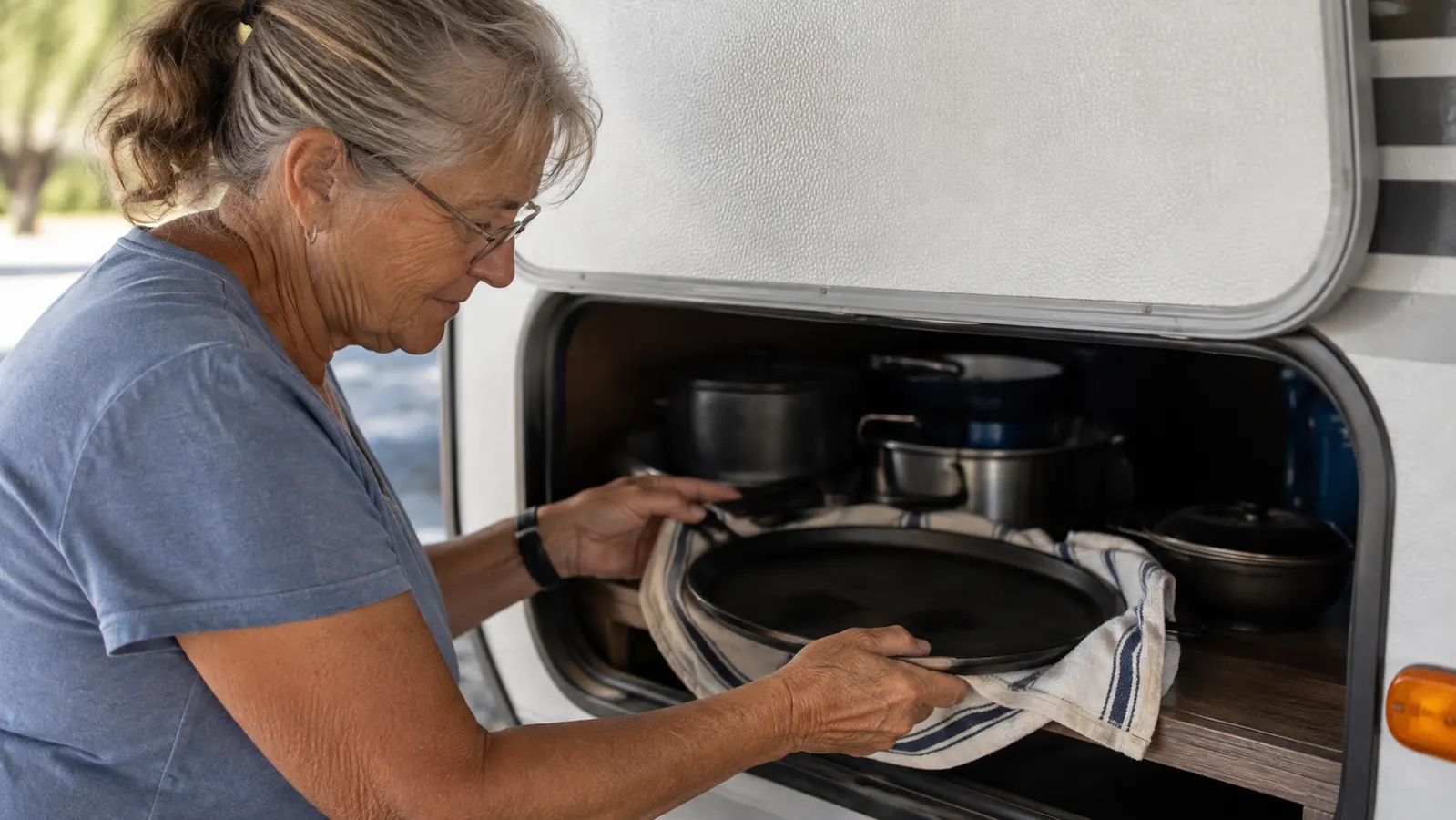
Storage between trips is simple now, though it took me a season to settle on. It lives flat on a shelf in the outside kitchen cabinet, wrapped loosely in a plain cotton towel rather than sealed in anything airtight, always fully dry and lightly oiled before it goes in, which after the rust scare I don't skip anymore. It never travels with the food storage, and it never sits on top of anything else that might trap moisture against it. That's the whole system, and three seasons in, it's kept the pan in better shape than I expected a piece of iron riding around in a trailer through every kind of weather to be.
What I Liked
- Genuinely improves with age, the seasoning after three seasons outperforms the pre-seasoned finish by a wide margin
- Bridges both burners on a standard two-burner camp stove and replaces two or three smaller pans
- Ribbed side lifts grease away from bacon and burgers, flat side handles eggs and pancakes evenly
- No warping after regular use over an open campfire, even with uneven heat
- PFAS-free cookware, one less thing I have to think about feeding my family
Where It Falls Short
- Heavier than any other single piece in my camp cookware, noticeable when lifting alone
- Rusts quickly if packed away damp in a closed space, learned that one the hard way
- Takes a full season or more of real use before the seasoning stops being sticky in spots
- Doesn't fit every stove or fire grate configuration, worth measuring your setup first
This pan didn't get easier to use because I got stronger. It got easier because I finally learned to move it right.
Who This Is For
If you camp often enough that you're cooking real breakfasts and dinners rather than just heating up something out of a bag, this pan earns its space fast. It's especially good for anyone cooking for more than just themselves, since one griddle covers what would otherwise take two or three pans and a lot of pan-swapping over a two-burner stove. It's also a good fit if you already own other cast iron and know the maintenance routine, because there's nothing new to learn here, just a bigger, flatter shape to apply the same habits to.
Who Should Skip It
If you have real trouble lifting or gripping heavier cookware, or if you're only cooking for one and mostly heating simple things, a smaller cast iron skillet will serve you better and cost you less in effort. And if you know you won't keep up with drying and oiling it after every single use, including the inconvenient times when you're tired and just want to get on the road, I'd think twice, because this pan punishes neglect faster than it rewards good habits. It isn't a pan you can treat carelessly and still expect to last.
One pan, three seasons in, still going strong.
This is the exact reversible griddle that's replaced three separate pans in my camp kitchen, ribbed side and flat side both still doing their job.
Amazon Check Today's Price on Amazon →