
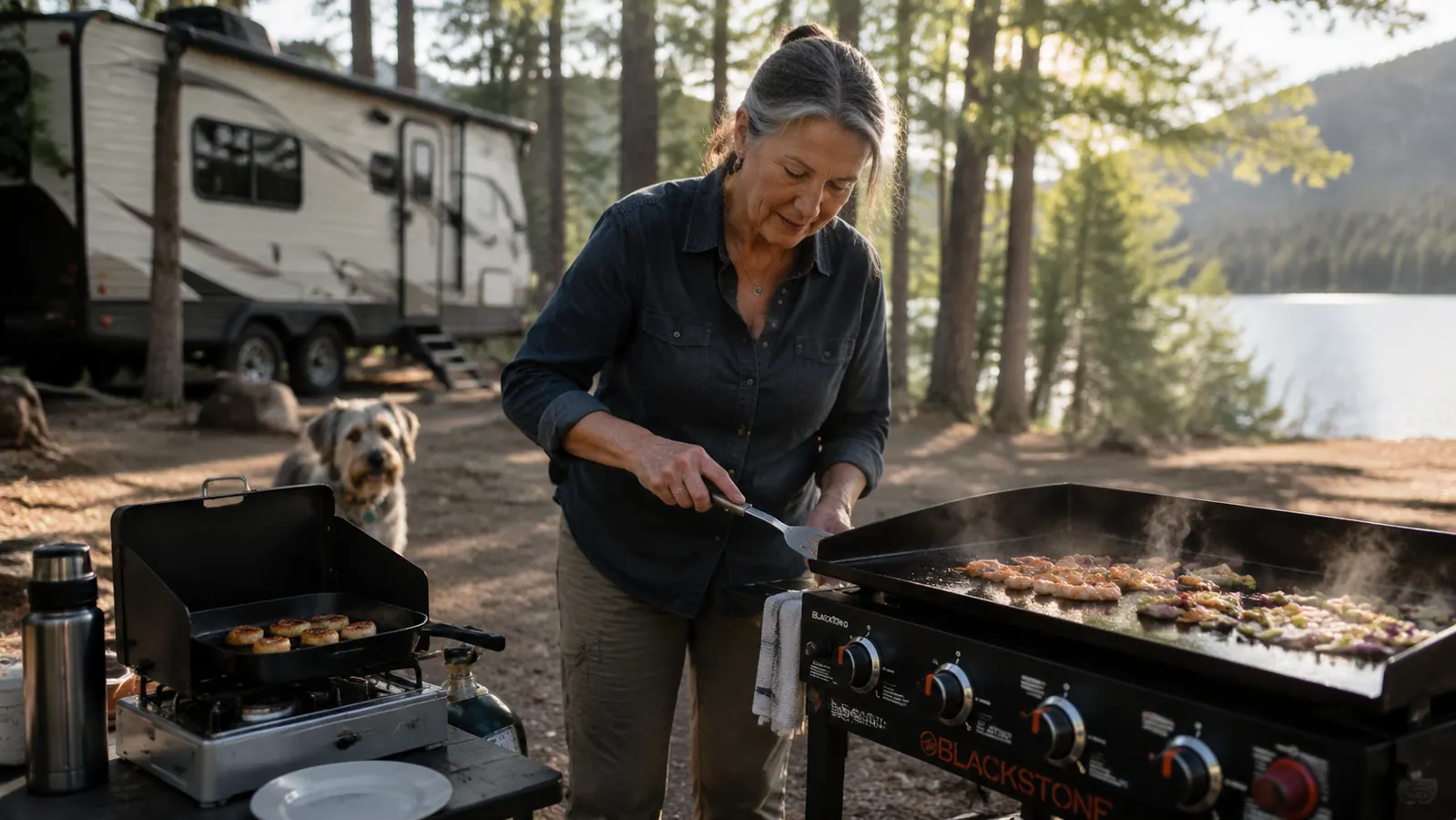
If you want the short version before I walk through all of it, here it is. I've cooked more meals on the Lodge reversible cast iron grill and griddle pan than on any other single piece of cookware I own, and it's the one that lives permanently in a cabinet in my trailer, not in a storage bin I have to dig through before a trip. My camping neighbor two sites down at a Corps of Engineers campground on Kentucky Lake runs a Camp Chef two-burner griddle system, and we've traded breakfast duty enough mornings over the past two seasons that I can tell you honestly where each one earns its keep. Camp Chef makes a genuinely good griddle. If I were cooking pancakes and bacon for eight people every weekend, I'd probably own one too.
But I camp alone most of the year, in a 24-foot trailer that's already tight on cabinet space, and I'm cooking for myself and whatever Biscuit manages to talk me out of. That difference, one person versus a crowd, one cook surface versus a whole standalone stove, is what this entire comparison comes down to. Here's how the two actually stack up, spec by spec, not just on paper.
| Lodge Reversible Cast Iron | Camp Chef Griddle | |
|---|---|---|
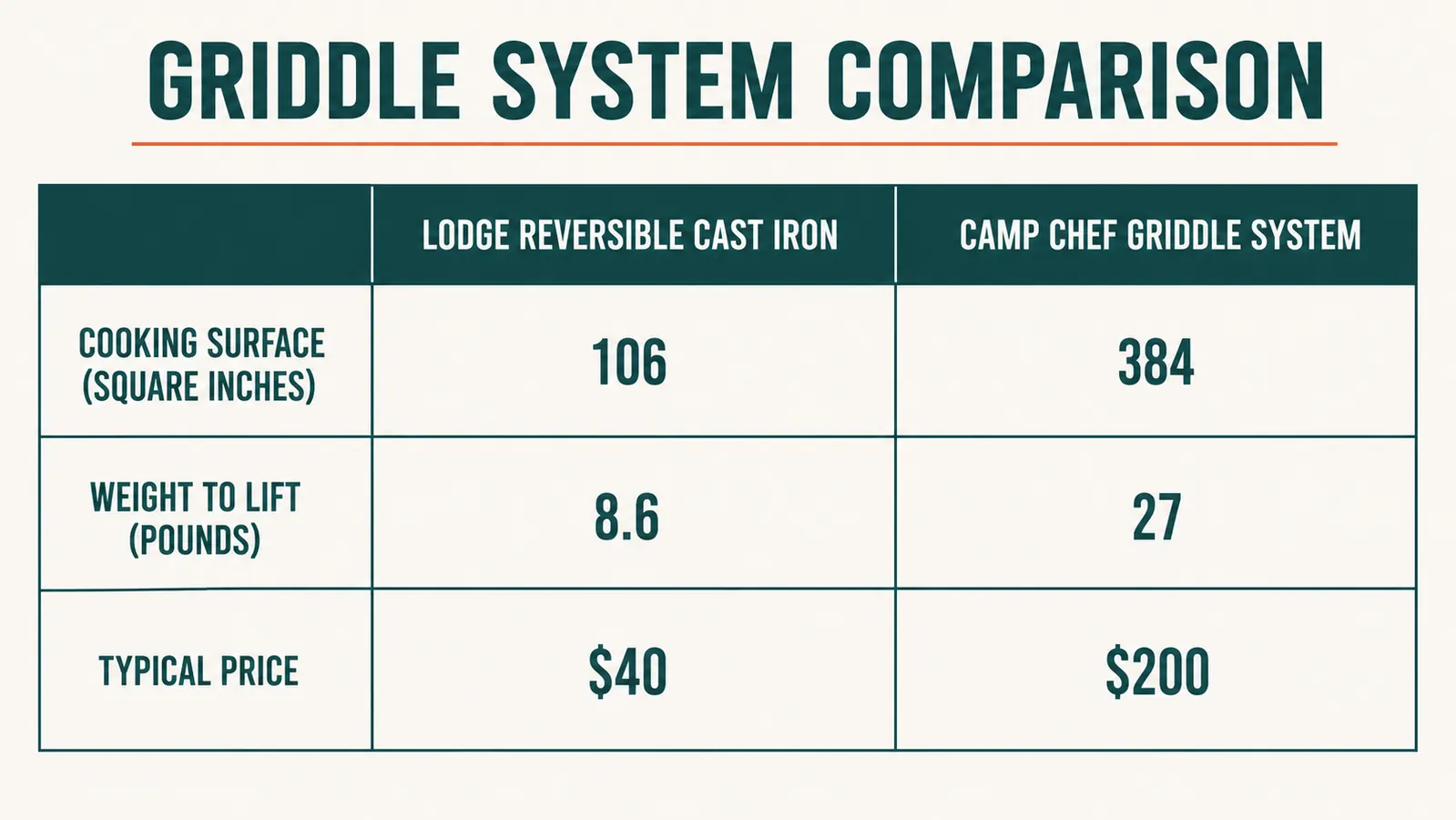
| Cooking surface area | 16.75 x 9.5 inches, about 106 square inches, one pan bridges a standard two-burner camp stove | Griddle top spans roughly 16 x 24 inches on most two-burner systems, about 380 square inches of flat cook surface |
| Weight and one-person handling | About 8.6 pounds, one hand lifts it off the stove and carries it to the sink | Griddle top alone runs 25 to 30 pounds, plus the stove base and legs, closer to 45 pounds fully assembled |
| Storage footprint in a trailer | Lies flat on a single cabinet shelf, no assembly, no separate stand or legs | Needs its own tote or under-bed bin for the base, legs, and griddle top together |
| Heat source flexibility | Works on a camp stove burner, a campfire grate, charcoal, or a home range, no fuel of its own | Runs on its own attached propane burners, so it needs its own fuel supply even if you already own a stove |
| Even heat across a big cook | One heat zone under a smaller surface, best cooking for one or two people in batches | Wider surface holds steady heat edge to edge, so a full batch of pancakes for six or eight cooks at once |
| Reversible ribbed and flat sides | Flips over, ribbed side lifts grease off bacon and burgers, flat side handles eggs and pancakes | Flat cooking surface only, no ribbed side for draining grease away from meat |
| Seasoning and day-to-day maintenance | Cast iron needs a dry, lightly oiled surface every time or it rusts, but the seasoning improves with age | Cold-rolled steel top also needs seasoning and an oil wipe, plus keeping the burner jets clear of grease drips |
| Price and lifespan | Mid-range, a piece of cast iron that can realistically outlast the trailer it rides in | Full two-burner griddle systems are considerably more expensive, with more moving parts that can wear out or need replacing |
Where Lodge Wins
Weight and storage are the whole argument for me. I load and unload my own trailer every single time I move to a new site, and that means every pan gets judged on whether I can lift it, carry it, and find a home for it without a second set of hands. The Lodge griddle weighs about 8.6 pounds and lies flat on one cabinet shelf. There's no stand to fold, no legs to collapse, no separate tote riding in the truck bed. I pull it out, set it on whichever heat source I've got that morning, and it's cooking within a couple of minutes.
The storage math is worth spelling out because it's the part that actually decides what stays in the trailer and what gets sold off at the next yard sale. My outside kitchen cabinet has one shelf about ten inches deep, and the Lodge griddle lies flat on it with room to spare on either side, sharing that same shelf with a smaller skillet and a saucepan. My neighbor's Camp Chef griddle top alone needs a bin roughly two feet long, and that's before you add the folding legs and the stove base, which live in a second tote under his truck's bed cover. In a 24-foot trailer where every cubic foot is already claimed by clothes, dog food, and the cats' litter box, one flat pan on an existing shelf beats a system that needs two new totes and a place to put them. That's not a small consideration when you're the one deciding what gets left behind on a trip to save space.
The heat flexibility matters just as much and it gets overlooked in most reviews I've read. This pan doesn't care what's underneath it. I've run it on my two-burner propane stove for most meals, set it straight on a campfire grate at Corps of Engineers sites where I felt like cooking the old way, and even used it on my kitchen range at home between trips to keep the seasoning from going stale over the winter. A griddle that's part of its own stove system can't do any of that. It's married to its propane burners, which is fine if that's the only heat source you'll ever use, but it's one more piece of equipment that has to work correctly for you to eat breakfast.
There's a real tradeoff hiding in that heat flexibility, and I'd rather tell you about it than let you find out the hard way. A 16.75 inch pan set across two burners means the middle of the griddle sits almost directly over one burner's flame while the far ends barely get touched by either one. On my stove, that shows up as a noticeably hotter center, maybe six inches across, with the outer few inches on each side cooking noticeably slower. I've learned to work with it rather than fight it. Bacon and the first batch of eggs go in that hot middle. Pancakes that just need to hold warm while the next batch cooks go out toward the edges. I also give the pan a quarter turn partway through a big cook, the same habit I use over a campfire grate, and that alone evens things out more than people expect. It's not a flaw exclusive to this pan, any flat surface bridging two separate flames does the same thing. It's just something nobody mentions until you've burned a few eggs figuring it out yourself.
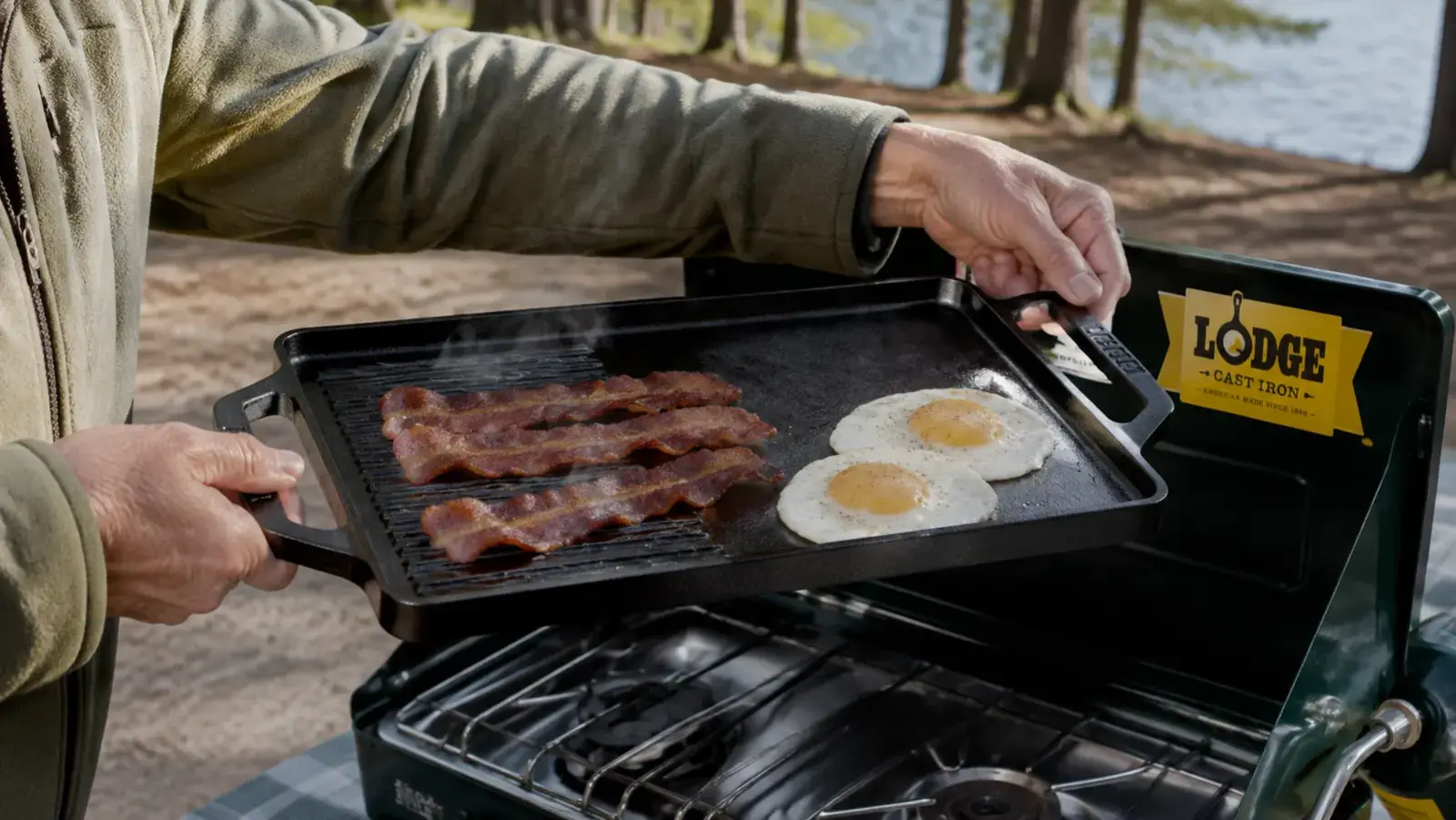
The reversible sides are the other reason this pan replaced three pieces of cookware instead of one. Ribbed side up, bacon and burgers lift out of their own grease, which matters when a picnic table isn't quite level and hot fat wants to run toward one edge. Flip it over, and the flat side takes eggs, pancakes, and grilled cheese, everything that needs full contact with the surface. On a fixed income, that matters too. I paid in the budget range for this pan, and it's already outlasted two cheaper nonstick skillets I bought before it. A Camp Chef system at the premium end might make sense if you're outfitting a whole camp kitchen from nothing, but it's a much bigger ask when you're just trying to replace what's rusting out in your cupboard.
A Typical Day With This Griddle
Here's what an actual day looks like so this isn't just abstract talk about specs. Most mornings I'm cooking for one, plus whatever Biscuit talks out of me, so I set the flat side up over one burner, crack two eggs and a couple strips of bacon, and I'm eating within ten minutes of lighting the stove. No second pan, no juggling a skillet and a saucepan on a stove that only wants to hold two things comfortably. That same pan comes back out at dinner more nights than I expected when I bought it. I flip it to the ribbed side for a single pork chop or a chicken thigh, let the ridges lift it up out of its own fat, and I get something close to a grill mark and a grill flavor without hauling out a separate grill grate or firing up charcoal for one piece of meat. Breakfast and dinner, same pan, wiped down and back on its shelf by the time I'm ready to sit outside with a book before the light goes.
Where Camp Chef Wins
I want to be fair here, because Camp Chef didn't earn its reputation by accident. My neighbor's setup covers close to 380 square inches once you count both burners under the griddle top, against roughly 106 square inches on my Lodge pan. That gap is enormous the morning you're cooking for a family of six or a whole group site full of grandkids. He can lay out pancakes, bacon, and hash browns all at the same time across one wide, evenly heated surface, and everybody eats together instead of in shifts while the next batch cooks.
The other honest point in Camp Chef's favor is that the griddle and the stove are the same purchase. If you don't already own a camp stove, buying a griddle system gets you both at once instead of needing a separate heat source underneath a standalone pan. For someone setting up a camp kitchen from scratch and planning to feed a crowd most weekends, that combined purchase can make more sense than mine and his are, admittedly, solving two different problems.
I'll also give Camp Chef credit for cleanup on a big cook. My neighbor scrapes his griddle top down with a metal spatula right after breakfast, wipes it with a paper towel, and he's done in a couple of minutes, no waiting for cast iron to cool before he can safely handle it. When you're feeding a full group and want the cook surface clear fast so the next thing can go on, that steel top has a real edge over cast iron's slower, more deliberate cooldown and oil-down routine.
Let me say plainly who this griddle is actually built for, because I don't want to bury it in qualifiers. Camp Chef's system is the right choice for group campers and families, full stop. If you're regularly pulling into a site with two or three tents, a stack of coolers, and six or eight hungry people expecting pancakes at the same time, a wide standalone griddle earns its size and its price. It's built for exactly that job and it does that job well. It's not the right choice for someone cooking alone or for a couple, and it's not the right choice if storage space in your rig is already tight, but for a big group cook, it's the more capable tool and I won't pretend otherwise.
One pan, no separate stove to haul, and it fits on whatever heat you've already got.
This is the same reversible cast iron griddle I use for nearly every camp breakfast, ribbed side for bacon, flat side for everything else, and it lives on a single cabinet shelf.
Amazon Check Today's Price on Amazon →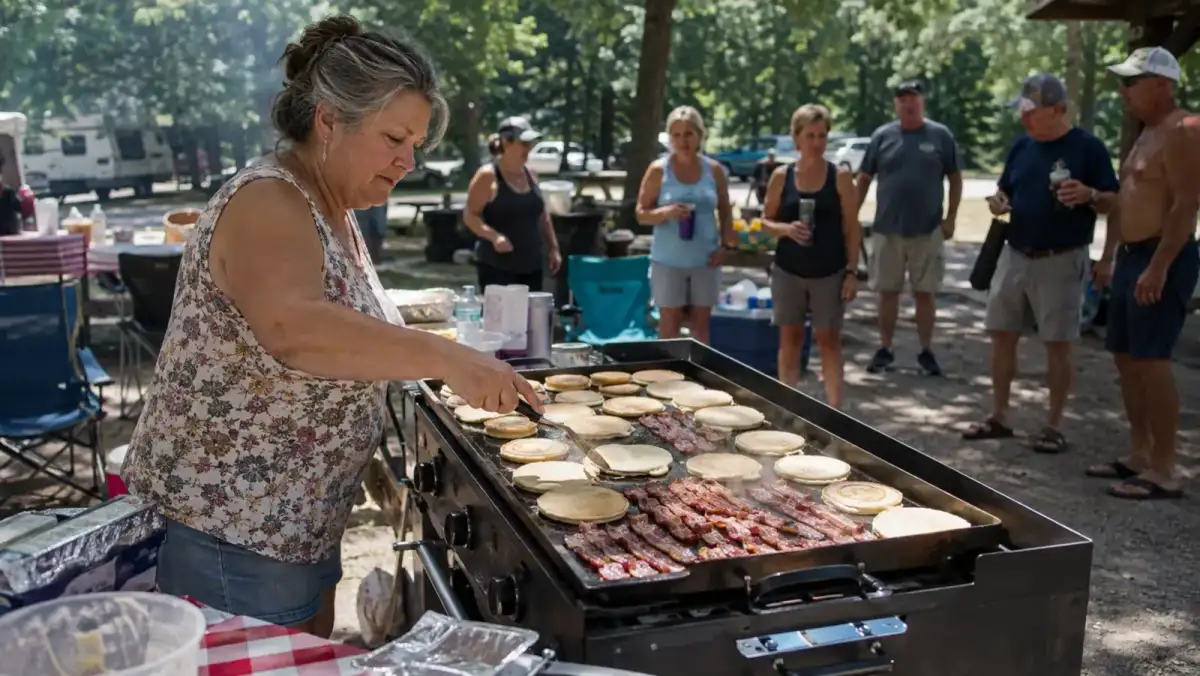
Who Should Buy Which
If you camp the way I do, mostly alone, mostly cooking for one or two people, and you're already carrying a camp stove or you cook over a fire ring some mornings, the Lodge reversible griddle is the easier answer. It costs a fraction of a full griddle system, it stores flat in whatever cabinet space you've got, and it doesn't ask you to haul a second appliance around a trailer that's already tight on room. If you're regularly cooking for a big group site, a family reunion at the campground, or you don't own a stove yet and want the griddle and the heat source in one purchase, Camp Chef's system genuinely earns its bigger price tag and its bigger footprint. Neither one of us is wrong about what we bought. We're just feeding different numbers of people.
I wrote up the full long-term picture after three camping seasons of daily use in my season-long Lodge griddle review, and there's an even blunter version, cons included, in my honest review. Between the two of them, you'll have everything I know about this pan before you spend a dollar on either option.
Feeding one or two people? Skip the extra stove.
Same griddle, same trailer, same two-burner stove I already own. It bridges both burners and packs away flat when breakfast is done.
Amazon Check Today's Price on Amazon →