
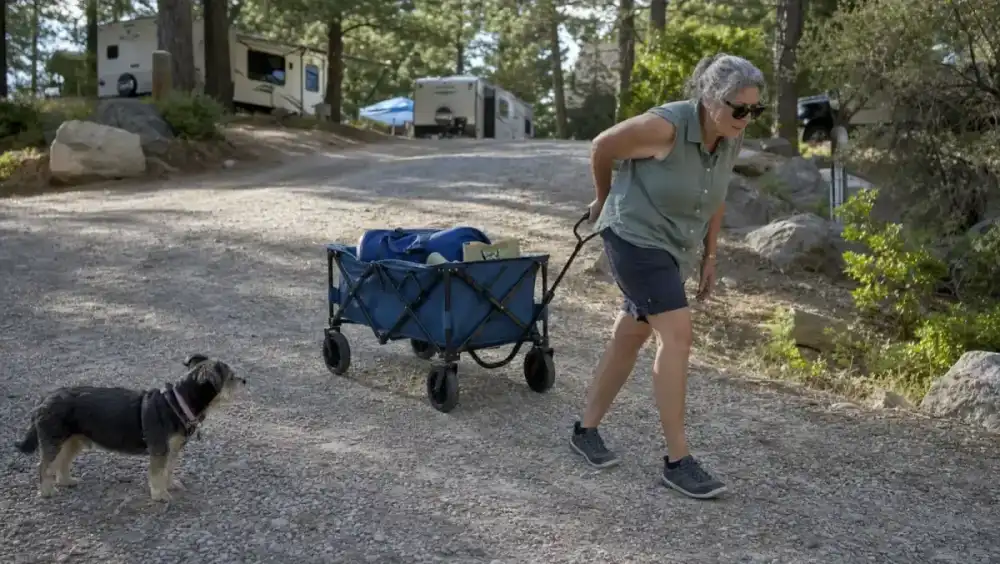
I read the reviews before I bought this Mac Sports wagon, same as anyone would. Nearly every one of them said the same three things: it rolls easy, it folds flat, it holds a lot of weight. All three of those are true, and I am not going to pretend otherwise. What none of those reviews mentioned is what happens when the ground under your wheels is not flat, dry, and freshly mowed, which at a real campsite is a lot more often than you would think.
I am Lorna Pruitt. I am sixty-six, I camp most of the year in a 24-foot travel trailer, and I set up every single site by myself with a dog named Biscuit for company and two cats who stay put inside once we are parked. Nobody hands me the other end of a wagon handle when the path turns uphill or the pad has a slope to it. This is not the review that talks you into buying this wagon. It is the one that tells you what the happy reviews leave out, so you know exactly what is coming before the box shows up at your door.
The Quick Verdict
It does the job of hauling camp gear alone, and it does it well on the ground most campsites actually have. But it has real limits on soft terrain, on slopes, on load, and on width that the glowing reviews never bring up.
Amazon Check Today's Price →Know what you're actually buying before it shows up at your campsite.
This is the Mac Sports wagon I am reviewing here, honestly, cons included. If you want to see today's price and specs for yourself, this is where I check.
Amazon Check Today's Price on Amazon →How I've Used It
This wagon has been in my trailer's pass-through bay for about a year and a half now, and I have pulled it loaded at every campground I return to, a Corps of Engineers site on Kentucky Lake, four different state parks, and two more Corps campgrounds besides. That is not occasional use. That is every single time I make camp and every single time I break it down, twice a stay at minimum, sometimes more if I am hauling groceries or firewood in on a separate trip.
I am not writing this the week the Mac Sports wagon arrived, when everything still feels new and nothing has had the chance to reveal its limits. I am writing it after enough seasons to have hit sand, mud, a slope with no flat spot on it, thick grass that had not seen a mower in weeks, and a bathhouse doorway that flatly would not let the thing through. Those are the parts of ownership nobody puts in a five-star review, because a five-star review usually gets written the first week too, back when everything is still smooth pavement and dry gravel.
I also want to be clear about what kind of camper is writing this, because it changes what counts as a flaw. I am not hauling this wagon down a half mile trail to a backcountry site. I am pulling it a few dozen feet to a few hundred feet, from a parking spur or a gravel pad to my own site, at established state parks and Corps of Engineers campgrounds. If that description does not match your situation, some of what follows may matter to you less. If it matches mine closely, pay attention to every section below, because I hit each one of these problems on ground that most campers would call ordinary, not extreme.
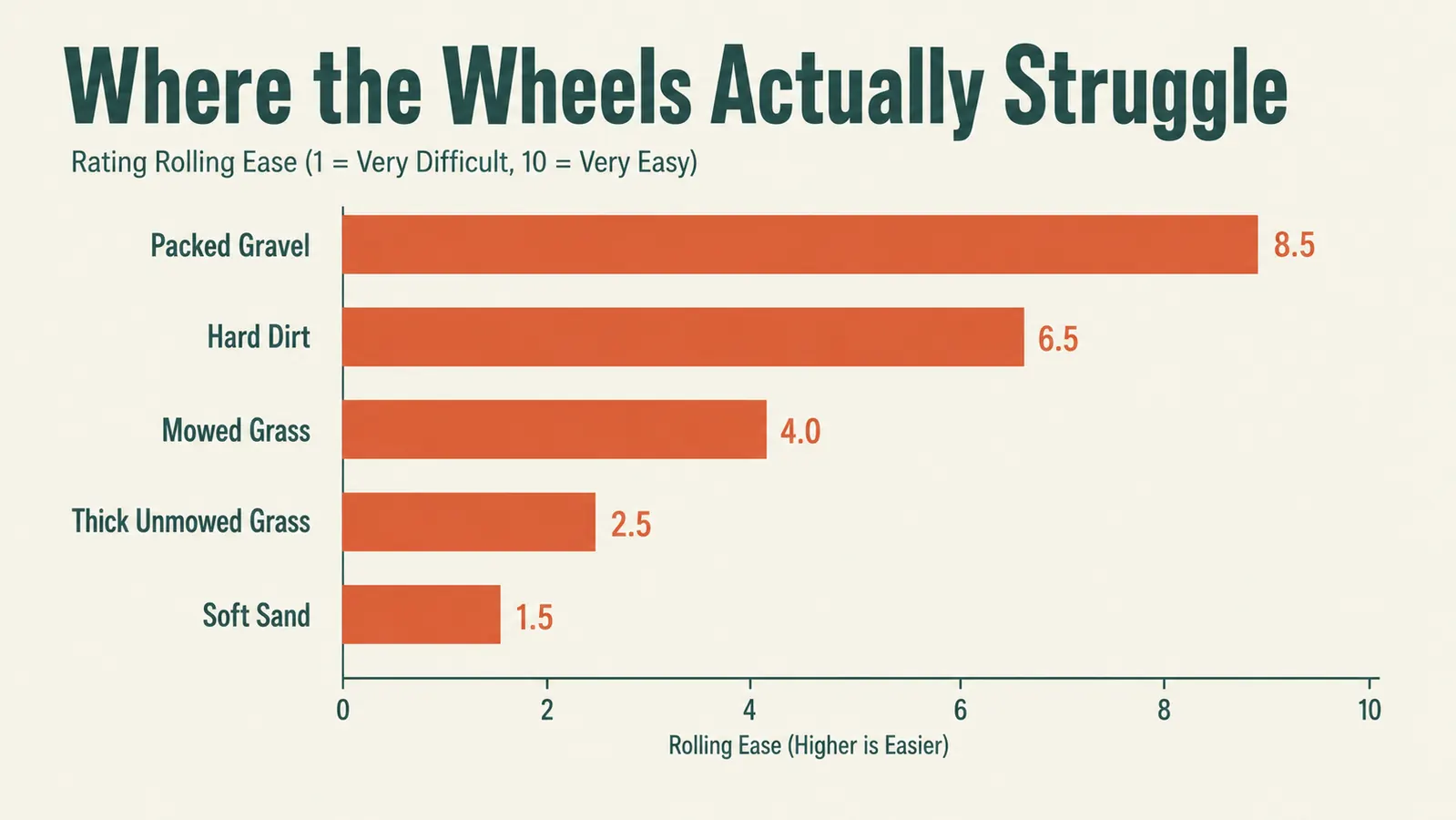
The Wheels Struggle Where the Wheels Struggle
On packed gravel and hard dirt, these wheels are genuinely fine. I want to say that plainly before I get into where they are not fine, because it would be dishonest to pretend the wheels are bad. They are not bad. They are just smaller and narrower than they look capable of in the product photos, and there is a real difference between a campsite pad that is packed and level and one that is not.
The first place I noticed it was a loop at one of my state parks where the grass along the walking path had gone unmowed for a few weeks before I arrived. Thick, tangled grass at that height grabs a small wheel the way it never grabs a boot. I had to stop twice and yank the Mac Sports wagon free where it had dug a shallow rut and stalled. It was not dangerous, just a genuine chore, the kind of pull where you feel it in your shoulder by the second stop.
Soft sand did the same thing at a different Corps campground, near a boat launch where the access path had gone loose and dry from foot traffic. The front wheels sank enough that I had to lift the frame slightly with each step just to keep it rolling, which defeats a good bit of the point of having a wagon in the first place. If your usual site has any real stretch of loose sand or unmowed grass between the parking spur and the pad, plan on that stretch being work, not a smooth roll.
What 150 Pounds Actually Feels Like, and Why It Is a Pull Cart
The listing says 150 pounds of capacity, and that number sounds generous until you actually load toward it. A full water jug alone runs close to forty pounds once it is topped off. Add a bag of firewood from the camp store, another fifteen to twenty pounds, a loaded cooler, and the two folding chairs I always bring, and I am well past the point where this stops feeling like a light errand and starts feeling like actual labor.
The frame has never buckled or complained under that kind of load. My complaint is not about the steel. My complaint is that this is a pull cart, not a push cart, and pulling a heavy load is a different motion than pushing one. You are walking backward or sideways, gripping a handle behind and below you, using your shoulder and lower back rather than your body weight. At one state park, the only route from the parking spur to my site ran up a short but real incline, maybe thirty feet of it, and pulling a loaded wagon up that grade left me out of breath at the top in a way that surprised me. Nobody markets a wagon around the idea that hills exist, but plenty of campsites are not flat all the way from the truck.
None of this means the wagon can't do the job. It means the 150 pound number is a ceiling on the frame, not a promise about how the load will feel in your hands and your back once you are moving it uphill by yourself, and I think anyone shopping for this wagon on the strength of that number alone deserves to know the difference before they load it up for the first time.
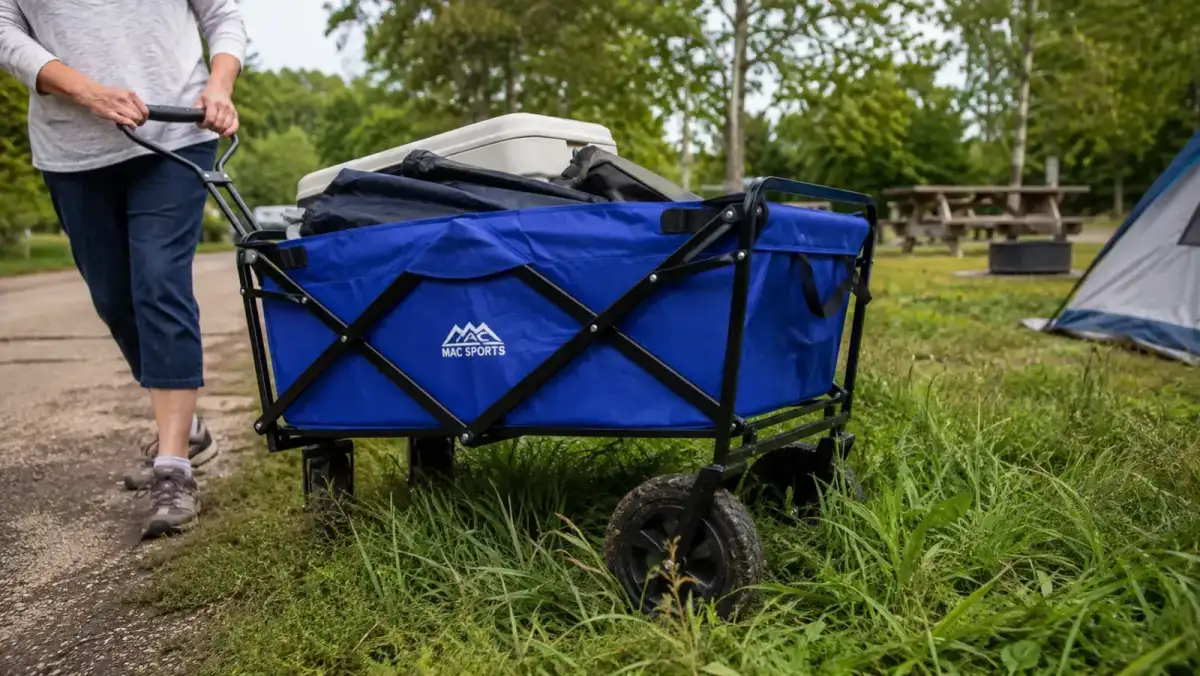
Folding It Clean Is a Different Skill Than Folding It
Folding this wagon down when it is clean and dry takes under a minute, and I will not take that away from it. Folding it down after a rainy stay at Kentucky Lake, with mud caked into the wheel wells and the fabric bed, is a different task entirely. The hinges get gritty and stop clicking smoothly, so instead of one motion, you are working the frame past resistance point by point, and whatever dried mud is on the wheels transfers straight onto the towel or the storage bag underneath it in the trailer bay.
I have gotten into the habit of hosing it down before I fold it after a wet weekend, even if that means standing out in a light drizzle a few extra minutes to do it. Skip that step once and you will spend the next stop scrubbing dried mud out of a fabric weave that does not forgive it easily. That is a real extra chore that a dry-weather review would never surface, and it is the kind of thing you only learn by owning one through an actual rainy stretch of a camping season.
The Fabric Bed's Blind Spot for Points and Corners
The canvas-style bed handles a soft, distributed load well, a cooler, a couple of blankets, a bag of dog food. What it does not handle gracefully is anything with a hard point or a squared corner. I load a plastic storage tote sometimes, and the corner of it has pressed a visible dimple into the fabric underneath over time, right where the corner sits, not spread across the bed the way a rounder load would settle.
I have started laying a folded towel or a scrap of tarp under anything with a hard edge before I set it in the bed, which solves the problem but is one more thing I have to remember to do every time. If you regularly haul folding tables, coolers with squared metal feet, or anything with a sharp corner, budget for that habit, because the fabric will show the pressure eventually if you don't, and a small dimple today is the kind of thing that becomes a worn patch a season or two from now.
What I Liked
- Rolls genuinely well on packed gravel, hard dirt, and mowed grass, no complaints there
- Steel frame has never buckled or flexed, even loaded heavier than I probably should
- One-person fold and setup once you know the trick, no second set of hands required
- Fabric bed handles soft, evenly distributed loads without issue
Where It Falls Short
- Wheels bog down in thick unmowed grass and soft sand, real work rather than a smooth roll
- It is a pull cart, and pulling a heavy load uphill is genuine physical effort, not effortless
- Folding it clean after mud or rain takes real extra work compared to folding it dry
- Fabric bed shows pressure dimples from anything with a hard corner or point
- No brakes at all, which matters the moment you are on any kind of slope
- Wider than it looks in photos, and some bathhouse doorways and narrow footpaths simply will not let it through
I did not need the reviews that told me it was perfect. I needed the one that told me where it wasn't, before I found out the hard way at a site with no flat ground and a doorway too narrow to matter.
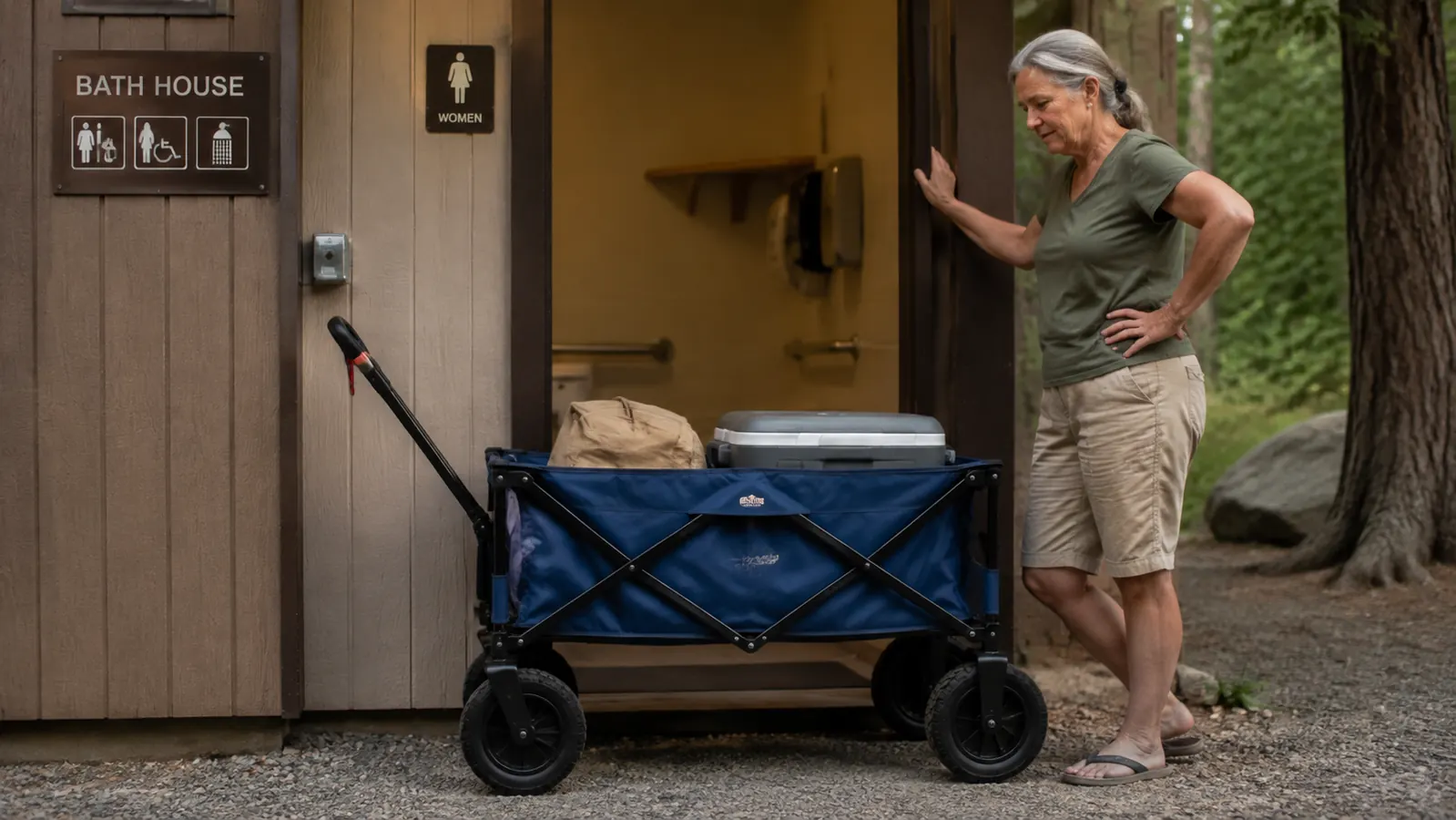
No Brakes, and the Doorway That Proved How Wide It Is
There is no parking brake on this wagon, and most of the time that fact never comes up, because most campsite pads are level enough that it doesn't matter. It mattered once, at a state park site with a graded slope running from the pad down toward the fire ring. I set the loaded wagon down for maybe ten seconds to unlatch the trailer door, and it started rolling on its own, slow at first, gathering just enough speed that I had to jog a few steps to catch the handle before it reached Biscuit, who was lying in its path without a care in the world. Nothing was hurt, but it was the kind of moment that tells you exactly what a missing feature costs you when the ground finally asks for it. I keep a piece of firewood in the wagon now specifically to chock a wheel if I ever have to set it down on anything but flat pad.
The width caught me off guard in a completely different way. I tried to wheel it straight through a campground bathhouse doorway to bring in a load of laundry supplies rather than carry everything by hand, and the frame simply would not clear the frame of the door. I had to leave it parked outside and carry the load in by hand anyway, which undid the entire reason I had brought the wagon along that trip. It is also a tight squeeze on a couple of the narrower footpaths between site posts at my more wooded state parks, tight enough that I have scraped a wheel well against a post more than once easing it through.
Who This Is For
If your usual campsites have level or gently sloped pads, packed gravel or hard dirt paths, and mowed grass rather than the overgrown kind, this wagon will do exactly what you want it to, and it will do it alone, without a second person, trip after trip. It is genuinely good at the job it was built for. If you camp mid-week the way I do, at state parks and Corps of Engineers campgrounds where the ground is generally kept up, you are in the range where this wagon performs the way the five-star reviews promise, and I would still buy it again knowing everything I know now.
Who Should Skip It
If your regular sites involve any real slope with no flat spot to park a loaded wagon safely, skip this one or plan to chock a wheel every single time, because there is no brake to save you from a moment of forgetting. If your access paths run through soft sand or grass that does not get mowed regularly, or if your route in passes through a narrow bathhouse door or a tight footpath between posts, measure before you buy, because this wagon is wider than the photos make it look. And if pulling a heavy load uphill is hard on your shoulder or your back the way it can be on mine, know that going in rather than finding out on your first trip. I go into more of the actual loading routine that keeps trips down to one in my guide to loading a collapsible wagon for camp, and I tell the fuller story of why I bought this wagon in the first place, and what it changed about camping alone, in the wagon that let me keep camping solo.
Buy it knowing exactly where it earns its keep and where it doesn't.
This is the same wagon covered here, cons and all. Check today's price and see the current specs for yourself before you decide.
Amazon Check Today's Price on Amazon →